French Island is not, of course, part of the Koo Wee Rup Swamp, but you can see it from the Swamp, especially if you go to the Swamp lookout tower on the South Gippsland Highway, where the Main Drain enters Western Port. French Island does have historical connections to local towns in the old Shire of Cranbourne through trade, sport, recreation and medical matters. There is a touching article in the
of August 22, 1895 about a French Island settler, 48 year-old William Warne, who had an accident when he was felling a tree and he was crushed by it. He was then conveyed two and a half miles on a stretcher to a boat, where they had to wait from mid-night until 4.30am until low tide, when he was rowed across to Tooradin, a voyage that took two hours. Dr Denton-Fethers, from Cranbourne met him at Tooradin and as William had to wait until the next day before he could be sent to hospital by train, the doctor
William was accompanied by Constable Cole of Lang Lang to Melbourne.
Another interesting connection between French Island and Lang Lang was that escaped prisoners from the Penal Settlement landed there or further down the Bay, but the Lang Lang Constables, including the aforementioned Constable Cole, spent his time looking for the escapees. In June 1918 an escapee, made it all the way to Sydney, before being caught, and Constable Cole was sent there to escort him back (1).
View of French Island from the Swamp look-out tower at Koo Wee Rup, taken January 2013.
Image: Heather Arnold
French Island, in Western Port Bay, is the largest island in Victoria and the largest island between Kangaroo Island in South Australia and Stradbroke Island in Queensland
(2). The size of the island has been listed variously as 15,400 hectares or 17, 900 hectares
(3). The first European explorer to reach Western Port Bay was
George Bass (1771 - 1803), who had left Port Jackson on December 3, 1797 in an open whaleboat, only 28 feet 7 inches long. Along with Bass there were six volunteers and six weeks of provisions. The purpose of the trip was to establish whether Van Diemen’s Land was an island or connected to the mainland. Bass entered Western Port Bay on January 5, 1798.
(4) This journey was a remarkable feat of navigation and confidence.
Bass set out from Sydney again on October 7, 1798 this time with
Matthew Flinders (1774 - 1814), in the Norfolk and they circumnavigated Van Diemen’s land, thus confirming the existence of the Strait, which was named after Bass. In 1801 the Lady Nelson, under the command of Lieutenant
James Grant (1772 - 1833), and later acting-Lieutenant
John Murray (1775-1807) visited Western Port and members of the crew planted a garden on Churchill Island, prepared the first chart of Western Port and also discovered Port Phillip Bay in January 1802, which they entered on February 14.
(5)
Bass, Grant and Murray did not realise that French Island, was in fact an island. It was the French under Captain
Jacques-Félix-Emmanuel Hamelin (1768-1839) in the Naturaliste who reached Western Port and circumnavigated and mapped French Island in April 1802, who discovered this. Hamelin was part of a French expedition, under the command of Captain
Thomas Nicolas Baudin (1754-1803), whose mission was to map the Australian coast and undertake scientific studies. Baudin was in the Geographe. They named the island Ile des Francais - Island of the French People. The arrival of the French in the area prompted the British to establish a short-lived settlement at Sorrento in October 1803, which was abandoned in May 1804.
(6)
In common with other parts of Western Port the first European settlers were sealers and other visitors to French island may have been residents of a settlement at Corinella established in December 1826 and abandoned in February 1828. The first legal settlers, John and William Gardiner who took up the French Island run in April 1847.
(7) The land was eventually surveyed and subdivided in the 1860s. Early industries on the island included the French island Salt Company, operated by Richard Cheetham, from 1869. Saltmine Point is a legacy of this business.
(8) Chicory was also grown until the 1960s and when the industry was at its peak there were 22 chicory kilns on the Island.
(9)
In the 1890s, Australia was in a depression thus a number of unemployed people were settled on French Island from 1893. They were given small farms and expected to become self-sufficient. It was not a success - lack of fresh water, lack of roads, poor land, difficulty of shipping in building and other supplies and shipping out produce were some of the reasons for failure. The village settlements were named Energy, Star of Hope, Industrial, Perseverance, Callanan's and Kiernan's
(10). Of course, some of the farmers did succeed and in an article in the paper in 1953 it said there were 35 farming families on the island
(11). They had sheep, grazing and crops - potatoes, peas and onions - but dairying was impossible due to the unreliability of getting the milk to market on the barges - which had to battle the tides and the weather. Rabbits were also a source of income with a report in
The Age of July 2, 1931 saying
Rabbits are numerous, and many trappers are obtaining fifty pairs nightly off Crown land. Great wastage is caused owing to the heavy cost of transport to Melbourne. During the Great War, over 30 men and one woman, who had a connection to the Island, enlisted
(12).
A bumper crop of pumpkins, grown on French Island, 1901
State Library of Victoria Image H34460
In 1916, the McLeod Prison farm was established on the south-east side of the island. It housed 127 prisoners and closed in 1975
(13). This was another source of agitation for the settlers - escaped prisoners, who even though their aim was to get to the mainland, they sometimes menaced the locals.
Access to the Island was improved when the train line reached Stony Point in 1889, and a regular service to Tankerton on the island was established. Cattle were taken by barge to Corinella or swam across on low tide from Stockyard Point. From around 1940, to supplement the regular ferry, Les Paterson, operated an ‘on call’ service from Tankerton to Stony Point, with his boat, Amanda. Emergencies involved maternity patients, the cartage of coffins and the deceased and the local cricket team
(14).
Ken Gartside also operated a barge from Tooradin to French Island from 1946. The Gartsides had 2000 acres on French Island. He was part of the Gartside family who operated the cannery in Dingley from the 1930s to the 1970s
(15).
French Island Barge, leaving Tooradin, 1962. Photographer: Neil Smith.
Neil Smith taught at Tooradin North State School before the Second World War. This photo was donated by his son, Roderic Smith to the Cranbourne Shire Historical Society.
French Island National Park covers 11,000 hectares of the Island
(16) and the rest of the land is privately owned French Island is not part of a local government area and so landowner don’t pay rates. However, they also have no electricity, have to use generators, have no made roads and of course rely on the ferry and barges for mainland access. As I said before, the ferry service runs from Stony Point on the mainland to Tankerton. The barge runs from Corinella to Point Leschenault, according to the Parks Victoria visitor guide
(17). Théodore Leschenault de la Tour (1773 - 1826) was the botanist on Nicolas Baudin's expedition to the Australia that I mentioned previously.
This is the French Island barge, landing at Point Leschenault, French Island.
Photo: Eric Shingles.
Eric and his cousin, Colin Young, the owner of the truck, made two trips to French Island recently to pick up a load of a cattle and a load of sheep, this photo was taken November 27, 2019.
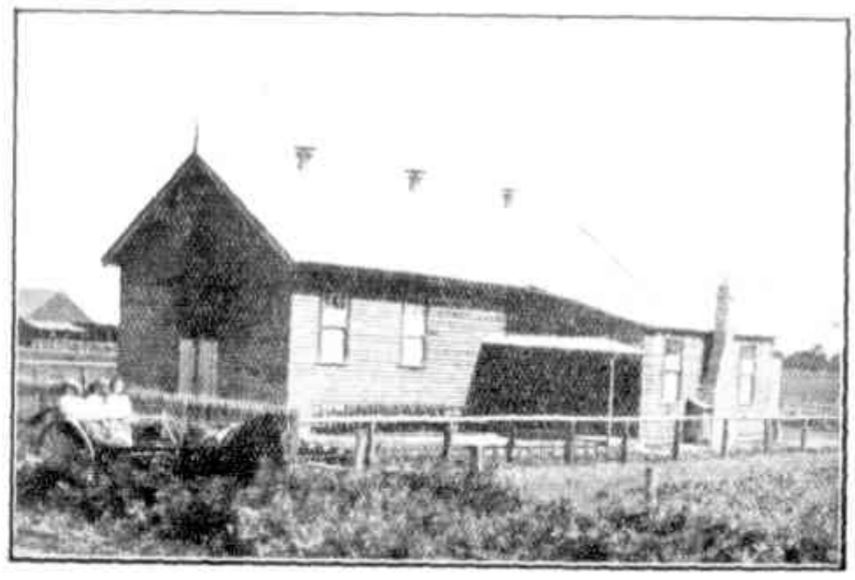
This photo of 'the old State School on French Island' was entered by Mr Windebank in a competition in
Table Talk and was published on April 3, 1930, see
here.
I am unsure if this was Perserverance, No. 3261 or Star of Hope, No. 3262. See below.
There is one primary school on the island at Perseverance, No. 3261 which opened in June 1896. It operated part-time with the Star Of Hope School, No. 3262. A letter was sent to the Education Department by a resident, John Christophers
(18), in November 1894 and he said that there were
47 school age children on the Island and this does not include the largest settlement, which I am assured contains from 20 or 30 children more. Both schools were originally wattle and daub huts with thatch roofs, fairly basic. By 1903 the average attendance at the schools were eleven at Perserverance and seven at Star of Hope. In 1907 new schools were erected at both sites
(19).
In 1911, the population was 149, 1933 - 204; 1954 - 178; 1961 - 228 and today the population is around 110
(20).
Footnotes