Friday, December 30, 2022

What happened in Garfield in 1923

This is a look back at what happened in Garfield, and surrounds, 100 years ago, in 1923, as reported in the newspapers. 

In February 1923, there was a complaint about progress of the works at the Garfield School - Several months ago tenders were let for additions to the local State school, and it was the intention of the Education department to have the work done during the Christmas vacation. For some unexplained reason the contract was not started. The department will now be put to the expense of hiring the local hall while the necessary additions are effected. (The Age, February 2, 1923, see here)

In the same month there was this report about the hooligan element in the town - It is the intention of the Garfield Traders' Association to urge on the Commissioner of Police the necessity of a constable being permanently stationed in the town. Since the withdrawal of the constable the hooligan element has been much in evidence. The breaking of shop windows has seemingly become a pastime. Other more serious offences have necessitated the service of the police and black trackers from Dandenong. During the potato digging season many undesirable characters visit the district. (West Gippsland Gazette,  February 6, 1923, see here)

A Sheaf-tossing prize was donated by Martin O'Donohue, the owner of the Iona Hotel at Garfield - Mr M. Donohue, of Garfield, has generously donated a valuable gold medal for the sheaf-tossing competition to be held at Garfield on 17th March. The event will be for the championship of Gippsland. (The Advocate, February 15, 1923, see here)


View of the Goods Shed at the Railway station in 1920. The Garfield Hall is in the background.
Berwick Pakenham Historical Society photograph

There was insufficient room at the Garfield Railway Station in February  - Great dissatisfaction is expressed at the lack of accommodation at the goods yard of the railway station. The existing platform is hardly sufficient to accommodate four trucks, whereon facilities for loading 14 or 15 trucks are required. Produce awaiting consignment is dumped on the ground for hundreds of yards up and down the line, where it remains for days before it can be loaded. (The Age,  February 15, 1923, see here.)

There were reports about bush fires in February and March - 
After a week of rising temperatures the climax was reached on Thursday, when 102 deg. was registered. Bush fires, driven by a hot north wind, sprang up in all directions, and a fire travelling south-easterly from North Garfield seriously threatened the buildings on the racecourse and the outskirts of Bunyip township. Fortunately a change in the wind to the west diverted the course of the fire. (The Age, February 24, 1923, see here)

A bush fire broke out about three miles north of Garfield, and, aided by a strong wind, it travelled with great rapidity towards the town. It swept through the properties of Messrs. Brennan, Robertson, Parish Bros.,and Dawes. Mr. Dawes' homestead had a narrow escape, the flames being checked within a few yards of the house. Beyond burning some hundreds of acres of scrub and short lengths of fencing, no damage resulted. Another scrub fire is burning between Garfield and Tynong. (The Argus, March 28, 1923, see here)

There was a follow-up report the next day - Smoke from bush fires is enveloping the town. Mr. H. Brew had his sheds, stables, and harness destroyed. A second fire destroyed all of Parish Bros' fencing on the Sale road, and three rows of apple trees were ruined. Mr. H. P. Hill lost a considerable amount of fencing, 150 passion fruit vines in full bearing, and several rows of apple trees. The corner of Mr. Limmer's house was burnt, and his orchard suffered severely. (The Argus, March 29, 1923, see here)

In March, there was good fishing to be had - Garfield - Good catches of blackfish are reported by parties visiting the Diamond and Back creeks. (The Age, March 1, 1923,  see here)

A farming report from March - Farmers in the Garfield district have this year gone in for cultivating field carrots on extensive lines. As from 30 to 40 tons an acre is produced, and the price generally runs from £2 to £3/10/ a ton, the crop should be very profitable. (The Weekly Times, March 10, 1923, see here)

In March there was a report about the impact of the new railway line to Strzelecki (also called the McDonald's Track railway), which had officially in June 1922, as  local farmers could now take their produce to Bayles, Catani and Yannathan.   I have written about the railway line, hereGarfield - The Kooweerup-McDonald's track railway is making its presence felt in many towns along the main Gippsland line. Traffic and business which for years past has gone to these towns is now diverted to the new outlet, and townships with good business openings are springing up along the new railway. Land values have advanced considerably, and range from £40 to £50 per acre. (The Age,  March 10, 1923, see here)

A fund-raiser for the Recreation Reserve - Garfield Carnival was brought to a successful conclusion on Saturday evening, the queen competition realising over £190. Miss Linda Reidy was the leading queen, followed by Miss Rita Brennan. The crowning ceremony took place in Garfield Hall, in the presence of a record gathering. The promoters of the carnival expect to raise £300. All of this amount is to be spent on improving Garfield Recreation Reserve. (The Argus, April 3, 1923, see here)

Good news in April - extended telephone time and the possibility of a policeman in the town - As the result of a deputation to the Deputy Postmaster General, the Garfield telephone exchange is to remain open until 8 p.m. daily. - The police authorities are endeavouring to obtain a house in Garfield to be used as a police station. Should their efforts be successful, a married constable will be placed in charge, and the station made independent of Bunyip. (The Argus, April 7, 1923, see here)

And some bad news - Garfield - Seed oats planted for fodder crop have failed to germinate during the past two months owing to the excessively dry season. Kangaroos, driven in from the hills to the north owing to the scarcity of feed, are destroying maize crops at North Garfield (The Age,  April 12, 1923, see here)

The Burnley Brass Band, paid a visit to the area at Easter -  Following its usual custom, the Burnley Brass Band, under the conductorship of Mr. W. J. Stove, journeyed to Gippsland during the Easter holidays, and supplied the music for several functions in the Garfield district. Arriving in Garfield on Good Friday evening, the band played selections in the township for two hours, and, despite the cold weather, the programme was heard by a large number of people. The Queen Carnival sports was attended on Saturday afternoon, while in the same evening the members travelled to Cora Lynn, where the annual dance was in progress in the local hall. The latest dance music was rendered by the band. On Sunday afternoon and evening special programmes were submitted to the Cora Lynn residents, and much appreciated by them. The collection taken up at the latter recital was handed to the Cora Lynn sports committee to assist any local object it may decide upon. A programme at the annual sports on Easter Monday concluded the trip, and the band arrived home on Tuesday, well pleased with their holiday. (Richmond Guardian, April 14, 1923, see here)

A complaint about the condition of the local roads - Garfield - The roads in this district are in a dreadful condition, particularly the 13 and 14 mile roads from lona and Vervale to Garfield. The local council has called tenders for metalling, but the contract was let too late to alleviate the position this year. The roads approaching the towns of Bayles and Catani, on the McDonald's track railway, are almost impassable. (The Age, August 4, 1923, see here)

Bush-fires at the start of the year and floods in October - At Garfield North, Cannibal Creek over-flowed, and the adjoining flats were converted into a lake. When going to school on Friday morning the teacher had to be carried across the creek. No scholars put in an appearance. During the morning the flood increased. The teacher remained a prisoner in her school until the arrival of a cart enabled her to recross the flooded creek. (The Argus, October 15, 1923, see here)

A seven inch rainfall during the past five days has caused one of the most disastrous floods in the history of the Kooweerup settlement. Scores of setters have been compelled to leave their homes, and thousands of pounds worth of damage has been done to growing crops. After continual rains on Thursday and Friday, the main canal into which the waters of the Bunyip and Tarago rivers flow 
commenced to rise rapidly until an early hour on Saturday morning, when the 20 ft. summer level gauge on the Junction-bridge disappeared beneath the yellow flood. The water continued to rise to the decking of the bridge, five feet above the gauge, carrying away the bank on the north side, leaving the bridge suspended across the stream in a dangerous condition. The sheet piling around the edge of the 15-mile-bridge was carried away, and the structure is likely to collapse. All other bridges were submerged, and until the water recedes the damage cannot be estimated. The flood poured over the high levee banks on either side below the Iona State school, and spread over miles of cultivated farms, and residents had to abandon their homes, leaving stock, poultry and pigs to fend for themselves. Cattle could be seen standing with their heads thrust above the water on Cora Lynn farms; many of the smaller animals were drowned. The flood rose to the height of six feet in the Cora Lynn cheese factory, and the mechanics' hall. State school and convent are isolated in an inland sea. Water flowed over the levee banks to a depth of four feet for a distance of four miles, and there is a grave danger of these giving way and causing further disaster.

Throughout Iona many thousands of acres of potatoes, oats and other crops have disappeared under water, and will be utterly ruined. The main roads along either side of the canal have been damaged beyond repair, and bridges over subsidiary drains are in a state of collapse
. (The Argus, October 15, 1923, see here)


Pioneers' Hall, Iona.
The Advocate November 16, 1922 http://nla.gov.au/nla.news-page20363246

In November and December a Queen Carnival was held to pay off the Pioneers' Hall, at Iona, I have written about the Hall, here.   Iona - To liquidate a debt of £450 on the Pioneers' Hall, a queen carnival was decided on some months ago, was successfully terminated on the 16th inst. Miss Madge Dowd represented lona; Miss Lila Gardner, Garfield; and Miss Alma Roberts, Bunyip. It was not until the last week that the carnival was taken seriously, and then action commenced in earnest. A bazaar was held in the hall, and the tug-of-war of stick-pulling was responsible for a packed house every night. The concert by Kooweerup artists eclipsed any previous entertainment. A feature of the affair was the support each queen received during the bazaar, but the lona organisation was perfect, thanks to the secretaries, Misses L. Kavanagh and H. Bennett. The crowning of the successful queen was splendidly carried out. The voting was:—Miss Madge Dowd, Iona, £191/1/4, 45, 856 votes; Miss Lila Gardner, Garfield, £139/1/9, 33,381 votes; Miss Alma Roberts, Bunyip, £95/1/11, 22,823 votes. As the major portion of the money was received during the last week, the result is regarded as highly satisfactory. Each queen was presented with a gold bangle. Miss E. Sullivan and Renie Maddigan acted as maids of honour, and Miss Frances Sullivan and Miss Lizzie Dowd train-bearers, for the successful queen, and Christopher Cooney as cushion-bearer. (The Advocate, December 6, 1923, see here)


The photograph of Carlo Catani which George Clowser presented
to the Iona Hall Committee.
My original photo of this portrait was enhanced by Paul Caine.

In December, George Clowser, Public Works Department paymaster, presented a portrait of the late Carlo Catani, Public Works Department Engineer, to the Iona Pioneers' Association. The portrait is now at the Berwick Pakenham Historical Society Museum. I have written about the portrait here and George Clowser, here. - At the annual banquet of the Pioneers' Association of Iona an enlarged  framed photograph of the late Mr Catani was presented to the hall committee by Mr G. Clowser, secretary for public works, who was formerly pay-master of the settlement when the swamp was first opened up, and Mr Catani was the engineer. Mr O. Kavanagh (president) accepted the gift on behalf on the committee. (The Argus, December 1, 1923, see here)  

Tuesday, December 6, 2022

Bayles General Store

The General Store at Bayles opened in January 1921, and the proprietor was George Petrie Murdoch Junior (1872-1972).  George also had the general store at Cora Lynn, which he opened in 1907 and operated  until 1922. You can read about George Murdoch and the Cora Lynn store, here

When I say the Bayles store opened in January 1921, that is actually the first advertisement that I found for it, and it was called the Yallock General Store. I was confused initially because I didn't know whether the Yallock Store referred to in the advert was actually in the 'old' settlement of Yallock or the 'new' Yallock, centred around the Bayles Railway Station. However, the Shire of Cranbourne Rate books  confirm that Murdoch's store was actually in Bayles ('new Yallock') not 'old' Yallock. George Murdoch is first mentioned as owning the land in the 1920/21 Rate books.

I was also confused as to why George would have opened his store in January 1921 when the Koo Wee Rup to Strzelecki Railway line, of which Bayles was the first station from Koo Wee Rup, wasn't officially opened until June 29, 1922. I knew that Bayles, as such did not exist before the railway line, it was the Railway Station closest to Yallock settlement.  However,  the railway stations were opened earlier for limited transport of goods (not passengers), whilst construction work was still going on. In the case of Bayles, it was February 1921  so that would have bought traffic to his store; the next stop down the line was Catani and it was opened for limited operations from May 1921. I have written about the Strzelecki Railway line, here, and about Frederick Bayles, the namesake of the town, here


First advertisement for George Murdoch's store at Bayles (then known as Yallock)
Koo Wee Rup Sun January 20, 1921, p. 1.

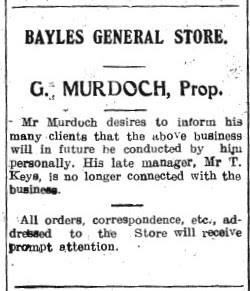
When the store opened in January 1921, Thomas Keys was the manager. However, as you can see by the advertisement, below, a year later he was no longer involved and George himself was operating the store and it had been renamed the Bayles General Store.


The store is now called the Bayles Store and Thomas Keys is no longer connected to the business.
Koo Wee Rup Sun, January 26, 1922, p. 3

By 1925, George was assisted in the store by his son Allan and daughter Mary Jane (according to their occupations in the Electoral rolls). In March 1927, the business was sold to Mr E. H. Kean, but George Murdoch retained ownership of the building (and had other properties in Bayles) until at least 1950.  The Electoral rolls tell us that E.H. Kean was Edmund Herbert Kean and his wife, was Helen May Kean. 


The Bayles Store is taken over by Mr Kean, and this advertisement shows the 
huge range of stock available at the store. 
Koo Wee Rup Sun, March 3, 1927, p. 4


Short advertorial advising the change of ownership of the store. 
Koo Wee Rup Sun, March 3, 1927, p. 4

Edmund and Helen Kean were at the Bayles Store until July 1936 when they sold to D.J. Cole, who previously had a business in Daylesford. The departure of the Keans from Bayles was much regretted as they were most desirable residents, as the Dandenong Journal told us. The Keans moved to Parkdale, where they had a store and later to Isabella Street, Mentone, where the Electoral rolls list Edmund's return to his occupation of mechanic.


The Keans leave Bayles.
Dandenong Journal, July 2, 1936  http://nla.gov.au/nla.news-article214740179

The new owner of the Bayles store was David James Cole. Also living there was his son Keith and his daughter-in-law, Joyce, as well as Joyce's sister Gwen Hoarth.   


Mr Cole takes over the Bayles Store as a going concern.
Koo Wee Rup Sun, July 9 1936, p. 1


Mr Cole's first advertisement.
Koo Wee Rup Sun, July 9, 1936 p. 4

David Cole had the store until June 1943. The Dandenong Journal of June 30, 1943 (see here), published a lovely report of the farewell function-
Farewell To Popular Bayles Storekeeper
The monthly euchre party and dance run by the Bayles Red Cross attracted a bumper house on 16th. inst., owing to the occasion being taken to express the district’s appreciation to Mr. D. J. Cole, Mr. and Mrs. Keith Cole and Miss Gwen Hoarth before they left the district. The euchre tournament attracted a large number of competitors, and Mrs. P. Wildes carried off the honors. Rogers' orchestra provided a happy evening for dancers, while Mr. Gordon Potter in his usual capable manner, acted as MC. During an interval Mr. Potter, in inviting the guests to a seat of honor, said it was a happy thought on the part of the local Red Cross to invite the Cole family to the function.

Cr. L. J. Cochrane referred to the generous support always given by the Cole family to all social and patriotic functions and for any cause for the benefit of the district. Mr. Cole came to Bayles in 1936 when district affairs were at a low ebb, but by his energy and industry, built up a prosperous business, and people were grateful for the many kindnesses extended to them. Miss Gwen Hoarth had for two years proved herself efficient and courteous in the conduct of postal and switch-board duties.

Mr. Cole has one son (Laurie) in the AIF., the youngest member of the family, Colin, is serving in the RAN., while Mr. Keith Cole is about to enter the RAAF. Cr. Cochrane concluded by wishing the guests long life, health and happiness wherever they may go. Mr. Cole, senr. thanked the speakers for their kind remarks and the Red Cross for the invitation to be present. He was sorry to be severing his connection with district affairs, he said, but Keith’s desire to enter the services caused him to make his decision. Mr. Keith Cole, in his usual happy style returned thanks on behalf of himself, his wife and sister-in-law. For they are “Jolly Good Fellows” brought a happy event to a close. As usual the ladies provided a dainty supper.

Laurie, Colin and Keith all returned home safely from the War. 

Mr Cole sells business to Mr Griffiths
Koo Wee Rup Sun June 10, 1943, p.4


From June 1, 1943, Mr A.J. Griffiths took over the store. I have not discovered his given names.  He was only there for three years but in that time the Dandenong Journal (1) reported that in 
February 1944 - Mr A. J. Griffiths advised that at a meeting of citizens at Bayles it was resolved, in view of the serious, menace of fire to the town and property in that area to form a bush fire brigade. Mr. J. G. Potter is captain, Messrs. E. Epps and S. McKay, lieutenants; and Mr. A. J. Griffiths secretary.
In September 1944, he sang the beautiful hymn, "Thine forever, God of love'' at the wedding of Peggy Hodgson to William Pearse, in the Koo Wee Rup Anglican Church, and also sang at their reception.
In October 1945, it was reported that a permit has been granted to A. J. Griffiths to erect a bulk food store at Bayies, at a cost of £450.
In January 1946 he unsuccessfully stood for Council.

Mr Griffiths was clearly a man who involved himself in the community life of Bayles. In June 1946, the store was taken over by S. & S. King - Stanley and Shirley Bonnaville King. 


Mr Griffiths last advertisement in the Koo Wee Rup Sun
Koo Wee Rup Sun June 5, 1946, p. 2


The first advertisement for the Kings in the Koo Wee Rup Sun
Koo Wee Rup Sun June 12, 1946, p. 4

Stanley and Shirley King were in the Electoral rolls at Bayles in 1954, but the 1958 roll, saw them living in Seaford, where his occupation is a grocer. Interestingly, the 1954 roll lists both Shirley and Stanley as 'general merchants' - married women rarely had an occupation specified, no matter how much the worked in the family business or on the family farm, they were usually just listed as 'home duties' 

What do we know about Stanley and Shirley? They were married 1940 at the Holy Trinity Church of England in Kew, and their wedding was reported in The Australasian of August 17, 1940. Shirley was the daughter of Cr and Mrs H.F. Mogg, the Mayor and Mayoress of Kew and Stanley the son of Mr and Mrs H.E. King of Bourke Road, East Malvern. Stanley died in May 1965, aged 54, at their home in Kananook Avenue, Seaford, and his death notice in The Age of May 17, 1965 lists three children, Robin, Clive and Mark. Shirley died in 1982, aged 71. 


The wedding of Shirley Mogg to Stanley King. 
From left - the bride and bridegroom, Mrs B.V. Mogg, Miss I. King and Miss Mary Shaw. 
The Australasian, August 17, 1940 http://nla.gov.au/nla.news-article142142165


The report of the wedding.
The Australasian, August 17, 1940 http://nla.gov.au/nla.news-article142142169

We will leave the Bayles Store with the Kings; however nearly 102 years after George Murdoch established the Store, it is still going strong.

Footnote
Sources for the information about Mr Griffiths
Dandenong Journal, February 9, 1944, see here
Dandenong Journal, September 13, 1944, see here.
Dandenong Journal, October 10 1945, see here
Dandenong Journal, January 16, 1946, see here.

Monday, December 5, 2022

Bayles Football Club - a poem

The Koo Wee Rup Sun of May 14, 1925 published this poem by Master A. Murdoch about the players of the Bayles Football Club. I am guessing that the poet was Archibald William Murdoch, the son of George Petrie Murdoch, who had the store at Bayles.  Archie was born 1909, and so would have been about 16 at the time - young enough to be called 'Master' and old enough to write the poem. George Murdoch also had the store at Cora Lynn from 1907 until 1922, read about this here. The poem is transcribed below.


Bayles Football Club poem 
Koo Wee Rup Sun May 14, 1925 p.3


Bayles Football Club by Master A. Murdoch

They are Black and White Magpies,
The king of all birds;
Some come from the factory-
They live on the curds.
There's Jeffers and Stewart and Murdoch and Kane; 
They never are beaten; they all come again.
And there's Tommy O'Brien and Bromeo Fred,
And Taylor, the butcher, to carve up the dead;
Harker, the captain, an old hand at the game,
Who never gets beaten or never goes lame.
There's butchers and bakers and shopkeepers, too
They're footballers all and they know what to do.
But what about Smithy and Dan Cunningham?
They're as good as the day they came out of the pram.
There's great big Bert Griffo, who works on a farm;
He's that big and hefty, he'll come to no harm.
There's poor old Bill Wise, the man with the watch;
They say he's too fat, but that is all bosh.
But what about O'Brien and Sage?
If Bayles get beaten they'll get in a rage, 
And if anyone tries to sneak into the plot,
Les Egan, on Charger, will run down the lot.
Look out! Here comes Egan with one of his rushes;
The men are all gasping, the ladies all blushes.
And there's Egans and Linehams, who plow in the furrow,
And by all that is holy we'll down Korumburra.