Sunday, April 30, 2023

RAAF plane crash at Garfield, January 17 1958

This report of the crash of an RAAF aeroplane at Garfield  is from the The Age, Saturday January 18, 1958 p. 3.  

Air Cadets unhurt in R.A.A.F. Crash
Schoolboys were on First Flight.

Twenty-five schoolboy members of the Air Training Corp escaped unhurt when an R.A.A.F. Dakota – taking them on their first air force flight – crashed in a paddock near Garfield, in West Gippsland, yesterday. Five members of the crew also escaped injury as the plane careered along the ground on its belly.

The aircraft was on a routine flight from Laverton to Sale where it was taking an Air Force scientist, Mr W. Rice, of Altona. The cadets who had been on a two-week camp at Laverton, were taken along for the ride to gain experience.

Wing-Commander G.H.N. Shiells, commanding officer of Aircraft Research and Development Unit at Laverton, who authorised the flight, said that if the plane had come down anywhere else but on a flat paddock everyone on board could have been killed.

The pilot, Flight-Lieut. L.A. Evans, of Laverton, did a magnificent job in missing power lines as the plane first crashed through a boundary fence and then bounced and jolted its way more than 500 yards across the rough paddock.

The plane blazed a shallow furrow in the hard ground before it finally came to rest in a great cloud of dust only 80 feet from a road which had high tension power lines along its edge.

 
The plane after the crash
 The Age, Saturday January 18, 1958 p. 3.  

No panic
Flight-Lieut. Evans said that they were half way to Sale when the port motor cut out. He decided to try to return to Laverton, but five minutes later the starboard motor also cut out.

“I didn’t have much time to think as the aircraft plunged down. I sighted a fairly large paddock and decided to try a ‘belly’ landing,” he said. “This is the second time I have made a wheels-up landing. The first was during the war when the under carriage of a Lincoln bomber failed and I made a forced landing at Townsville, in Queensland.”

One of the cadets on board, 14 year-old M. Latham, of Frankston, was sitting by a window near the port engine. He said his only thought as they were approaching for the crash landing was…”What happened if it explodes?”

“The first I knew of the crash-landing was when I saw shattered fence posts flying past my window,” he said. “None of the boys showed any signs of panic as we hit the ground and I only felt a series of severe bumps and jolts before the aircraft finally stopped.

“As soon as we stopped moving we all started talking and shouting, but we were told to leave the plane as quickly as possible.”


The cadets line up with the damaged aircraft in the background.
 The Age, Saturday January 18, 1958 p. 3.  
 
Girl Watched
Patricia Terrill, 16, who lives just opposite the paddock in which the plane landed, was watching it when the engines failed. “I watched the plane coming down towards the paddock and then I raced into the house as it came full-pelt towards me,” she added. An R.A.A.F. official said last night that a full investigation would be held into the cause of the accident. He said the aircraft would be dismantled and conveyed to Laverton in pieces to be examined by experts.

About six hours after the crash an R.A.A.F. bus arrived from Melbourne and the cadets were taken back to camp.

......................................................................................  

Note: Article has been re-paragraphed. The Age article is from newspapers.com, and original is below.


 The Age, Saturday January 18, 1958 p. 3.

......................................................................................................................................

Bunyip News article
The December 2022 issue of the Bunyip News had an interview with, and photos of, Ken Sumsion, who was one of the cadets on board the RAAF plane when it crash landed at Garfield. He was 15 years old at the time. The article was written by Roman Kulkewycz and you can access it here  https://bunyipnews.org.au/#editions

..................................................................................................................

ADF-SERIALS: Australian & New Zealand Military Aircraft Serials & History website
This website - ADF-SERIALS: Australian & New Zealand Military Aircraft Serials & History - RAAF A65 Douglas C-47, C-49, C-50 and C-53 http://www.adf-gallery.com.au/2a65.htm has the following information about the ill-fated RAAF plane which crashed at Garfield. It says the plane took off from Moorabbin; The Age article says Laverton, which is where the Air Force base is located. 

RAAF Serial - A65-99 
Radio call-sign - VHRFP 
Model/Type C-47B-30-DK 
C/N - 33103 
USAAF Serial - 44-76771 

C-47B-30-DK constructed under USAAF Contract AC535-AC-40652- #2032. Ex 44-76771 ordered under Indent 2415 (6th of 10 C-47B Aircraft Batch, delivery from USA to Australia May 45). Rec 3AD ex USA 11/05/45. Renumbered and given DAT Rego VHRFP. Rec 13ARD ex 3AD 17/05/45. Rec 35 Sqn RAAF ex 13ARD 23/05/45. Coded BK-O. Rec 2ADex 35 Sqn RAAF 11/12/45. Issued 35 Sqn RAAF ex 2AD 21/12/45. Rec 36 Sqn RAAF ex 35 Sqn RAAF 12/04/46. Cat B Storage ex Schofields UE 20/05/48. Issued 86 Wing Det Garbutt Townsville 20/05/48.Rec 86 Wing ex Garbutt 20/06/49. Rec 3AD ex 86 Wing 12/08/49. Rec 86 Wing ex 3AD 10/11/49. Rec 86 Wing Det Darwin ex 86 Wing 19/05/50. Rec 86 Wing ex 86 Wing Darwin Det 20/07/50. Rec DAP ex 86 Wing 22/08/50. Rec 1AD ex DAP Parafield 25/08/51. Rec R/S East Sale ex 1AD 08/06/51. Rec 86 Wing ex R/S East Sale 17/08/51. Damaged from storm 10/11/52. Rec DAP ex 86 Wing 16/11/53. Rec 86 Wing ex DAP 10/05/54. Rec DAP ex 86 Wing 26/01/56. Rec ARDU ex DAP 02/08/56. Rec DAP ex ARDU for SARAH Modification 02/01/57.Rec ARDU ex DAP 19/02/57. Accident 1000hrs 17/01/58 after taking off on a ILS Check flight to East Sale from Moorabin Vic, when in flight, port engine failed, followed soon by the starboard engine, near Warragul Vic, forcing pilot to make an emergency forced landing in a paddock( owned then by Mr Edward Walters) damaging some 25 yards of fencing, one mile southeast of Garfield, Gippsland Vic. Crew; F/Lt L A Evans Serv#022135, W/o F Russell Serv#A31517, Sgt W R Ross Serv#A33211, A/c G F Green Serv#A218463, Mr Rice Scientific Officer ARDU(Civilian) and twenty Melbourne ATC members were not injured. Aircraft retrieved by 1AD, deemed unrepairable by unit and listed for disposal 06/01/59.TTHrs 4886.35. Rebuilt by Bristols 1960. VH-PNA Papuan Air Transport 'Mount Victoria' Registered 23/08/61. Ansett Airlines of PNG Registered 01/07/72. Withdrawn 30/10/72 Madang. Used for fire practice 11/72. Scrapped . Pics held of aircraft post forced landing.

Sunday, April 23, 2023

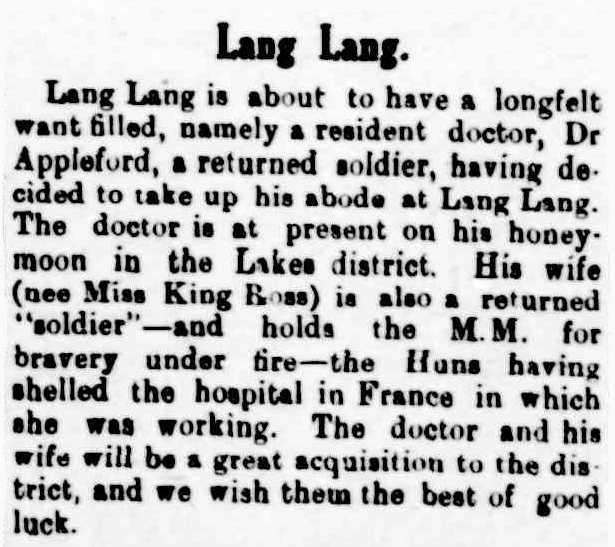
Doctor and Mrs Appleford, M.M. arrive in Lang Lang

Lang Lang had good news in September 1919 as Dr Appleford and his wife, Nurse Alice Ross-King decided to settle into the town -
Lang Lang is about to have a longfelt want filled, namely a resident doctor, Dr Appleford, a returned soldier, having decided to take up his abode at Lang Lang. The doctor is at present on his honeymoon in the Lakes district. His wife (nee Miss King Ross) is also a returned "soldier"- and holds the M.M. for bravery under fire - the Huns having shelled the hospital in France in which she was working. The doctor and his wife will be a great acquisition to the district, and we wish them the best of good luck. (1).


Dr Appleford comes to Lang Lang
South Bourke and Mornington Journal September 11, 1919

Dr Appleford also consulted at Koo Wee Rup, at Mr T. Burhop's  and Grantville on 'sale days'.


Where to consult with Dr Appleford
Koo Wee Rup Sun Nov 12 1919, p. 1

The Applefords lived in a house beside the Butter Factory in Station Street (2) and started operating a private hospital. Dr Appleford treated the usual range of ailments and incidents common in a country town, including treating the 54 people injured in the Christmas Eve train accident of 1928, when a passenger train hit a stationary goods train at Koo Wee Rup (3).  Here are some other reports of his medical cases, including happy births and sad deaths.


Birth of Jean Chisholm at Dr Appleford's Hospital
The Argus, January 15, 1921 http://nla.gov.au/nla.news-article1732810

Birth of baby Goudie at Dr Appleford's Hospital
The Argus,  January 26, 1924 http://nla.gov.au/nla.news-article1914771


Death of young William McCord at Dr Appleford's Hospital

Other reports of Dr Appleford's cases -
Bee Attack - Unbeknown to his mother, Colin Leeson, the 14 months’ old child of Mr. and Mrs. A. Leeson, of Caldermeade, followed his mother to the garden and sat down in front of a bee-hive, and as a result the bees attacked him and stung him severely round the head. The child’s screams attracted his mother’s attention, and she was severely stung in rescuing him. He was hurried to the surgery of Dr. Appleford, of Lang Lang, who ordered his removal to a private hospital for observation, in case poisoning and shock should supervene. The child has since returned home apparently none the worse for his adventure (4)

Snake bite - A resident of French Island was attacked and bitten by a tiger snake during the week-end. He was brought into Lang Lang, where he was given treatment by Dr. S. T. Appleford, who ordered his removal to a public hospital (5).

Shooting accident - Stanley Jackson, aged 16 years, son of Mr. and Mrs. J. Jackson, of Lang Lang, nearly lost his left hand as the result of an accident while he and three friends were out shooting. The gun exploded while he was trying to fix the safety catch. One of his companions stripped his shirt and bound the arm. After supporting Jackson in turn as they made their way back to the vehicle, they brought him into Lang Lang, where has was treated by Dr. S.T. Appleford, who ordered his removal to Melbourne. An operation was immediately performed, and it is believed that the youth's hand will be saved. (6)

The Applefords also joined in with the community life of Lang Lang - Alice Appleford was a member of the Lang Lang State School Mother's Club and President in 1934 and 1935. The couple's four children - Isobel, Marion, John and Richard -  all attended Lang Lang State School. She was also a member of the Lang Lang R.S.L. Women's Auxiliary.  Sydney Appleford was a founding member of the Lang Lang Tennis Club and President for the first fifteen years; a member of the Lang Lang Golf Club Committee (7).


The Appleford's farewell function
Dandenong Journal March 6, 1940 http://nla.gov.au/nla.news-article216060046

In 1940, Dr Appleford sold his practice to Dr Alan Hewitt of Koo Wee Rup, as he had enlisted in the Australian Medical Corps. The family left Lang Lang at this time and moved to 255 Buckley Street, Essendon. 


Sydney Theodore Appleford was born on August 29, 1891 in Geelong to John and Mary (nee Knight) Appleford; he attended Geelong College and then studied Medicine at Melbourne University. Sydney applied for a Commission in the Australian Army Medical Corps on August 24, 1915 when he was 23 years, 11 months old. He left for service overseas in the October and then returned to Australia in September 1916 on medical grounds (gastritis). He recovered and was sent back overseas in February 1917. In July 1918,  he was promoted from Captain to Major. Dr Appleford Returned to Australia January 14, 1919. It was during the voyage home that Sydney Appleford met his future wife, Sister Alice Ross-King, and they married in Melbourne on August 20, 1919.  Dr Appleford re-enlisted in the Army in the Second World War on April 12, 1940 at the rank of Lieutenant Colonel, and was discharged in January 1949. (8). He died on September 20, 1959 and is buried at Fawkner Cemetery. (9).

There  is a short and interesting biography of Dr Appleford on the Geelong College website, here

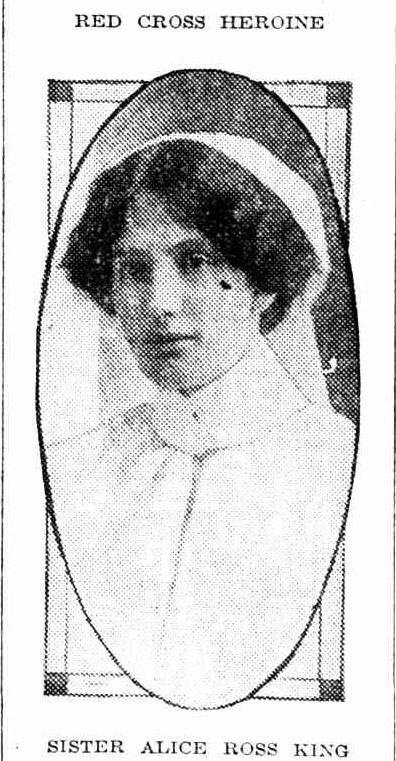
Sister Alice Ross King
Weekly Times October 6, 1917 http://nla.gov.au/nla.news-article132695390

Dr Appleford's wife, Alice, had also served in the First World War, and as we saw in the article at the top of the post, she holds the M.M. for bravery under fire - the Huns having shelled the hospital in France in which she was working. Alice Ross-King was born on August 5, 1887, in Ballarat, the daughter of Archibald and Henrietta (nee Ward) Ross King. She was actually christened Alys, but generally used Alice. She trained as a nurse at the Alfred Hospital and also worked at the Austin, Mildura and Wentworth Hospitals. Alice enrolled in the Australian Army Nursing Service on November 5, 1914.When she arrived in Egypt she was assigned to a Clearing Hospital for Gallipoli casualties. In April 1916, the Australian General Hospital, to which she was attached, was transferred to France. On July 22, 1917 the hospital was bombed and for her bravery, Sister Ross-King was awarded the Military Medal, one of only seven Australian Nurses who received this award during World War One. The award was gazetted in the London Gazette of September 25, 1917 and appeared in the Commonwealth of Australia Gazette on January 24, 1918 (10)


Sister Ross-King awarded the Military Medal
Commonwealth of Australia Gazette. January 24, 1918, p. 83. http://nla.gov.au/nla.news-article232463297

In November 1918, Sister Ross King was awarded the Royal Red Cross decoration in recognition of her valuable service with the Army in France and Flanders. The Royal Red Cross decoration was the initiative of Queen Victoria to reward women who showed exceptional service and dedication in nursing sick and wounded servicemen, whether at home or abroad. (11).  Sister Ross-King's diary, 1915 - 1919, has been transcribed and can be read on the Australian War Memorial website, here.


Sister Alice Ross-King awarded the Royal Red Cross decoration
Commonwealth of Australia Gazette. November 7,  1918, p. 2111. 

Lorna Finnie, the author of Sister Ross-King's Australian Dictionary of Biography entry describes her service in World War two - She enlisted for full-time duty with the V.A.D.s and her husband was commissioned as a medical officer in the army. By 1942 the V.A.D.s had developed into the Australian Army Women's Medical Services and Alice Appleford was commissioned as a major and appointed senior assistant controller for Victoria. Untiring in her devotion to duty and hard work, with responsibility for some 2000 servicewomen, her organizing skills had great impact on fund-raising activities during World War II. She was fully committed in assisting Red Cross and Service charities, supporting war widows and children and demonstrating concern for the well-being of members of the A.A.W.M.S. (12). 


Major Alice Ross-King
Australian War Memorial Image 080772 https://www.awm.gov.au/collection/P11013368

Alice Appleford died August 16, 1968 in Sydney and she is buried with her husband at Fawkner Cemetery. (13)

Footnotes
(1) South Bourke and Mornington Journal, September 11, 1919, see here.
(2) Coghlan, Barbara Protector’s Plains: history of the Lang Lang Primary school No.2899, 1888-1988 and district (CBC Publishing, 1988), p. 22.
(3) Photographs here - https://kooweerupswamphistory.blogspot.com/2020/02/railway-accident-at-koo-wee-rup.html ; Accounts of the accident -  The Argus, December 26, 1928, here; Weekly Times,  December 28, 1928, hereThe Australasian, December 29, 1928, see here. There are varying reports of the number of people injured - The Argus says it was 54 passengers; The Weekly Times 48 passengers and the Koo Wee Rup Sun of January 2, 1928 says it was 52 passengers. 
(4) Dandenong Journal, January 25, 1934, see here.
(5) Dandenong Journal, April 11, 1935, see here.
(6) The Age, July 9, 1935, see here.
(7) Dandenong Journal, May 11, 1933, see here and Coghlan, op. cit; The Age, July 16, 1937, see here; Great Southern Advocate, September 24, 1936, see here; Great Southern Advocate, April 23, 1936, see here.
(8) Military Service - WW1 Attestation file at  the National Archives of Australia, see here; WW2 Attestation file at the National Archives of Australia, see here.
(9) Death notice, The Age September 22, 1959, p. 15.

The Age September 22, 1959, p. 15. newspapers.com

Isobel Appleford married Arthur Roy Mansfield Watson in 1941;  Marion Appleford married Lieutenant Geoffrey Howard Sanders, RAN, on July 19, 1948, see a report of the wedding in The Argus June 21, 1948 here;
(10) Finnie, Lorna M  Alice Ross-King (1887 -1968), Australian Dictionary of Biography (ADB) https://adb.anu.edu.au/biography/rossking-alice-8276. Military Service - WW1 Attestation file at  the National Archives of Australia, see here.
(12) Finnie, op. cit.
(13) The ADB entry has her death date as August 17 1968,  but the death notice from her son, John has the date as August 16.

The Age, August 19, 1968, p.14. newspapers.com

The Age, August 20, 1968, p. 21, newspapers.com


This is an updated and expanded version a story, which I wrote and researched, which appears on my work blog, Casey Cardinia Commemorates: Our War Years

Saturday, April 22, 2023

Welcome Home at Koo Wee Rup

In April 1918, Koo Wee Rup boys, Les Cochrane, Bill Gilchrist and Billy McGree arrived home after fighting in France. They were welcomed home by their friends at the Railway Station. 


The boys were welcomed at the Railway Station
Lang Lang Guardian, April 20, 1918 http://nla.gov.au/nla.news-article119515345

On Friday, April 26 1918 a Welcome Home was held for the trio at the Koo Wee Rup Hall. We are fortunate to have this photograph of the occasion. 


Welcome home to Les, Bill and Billy.
Image: Koo Wee Rup Swamp Historical Society

The Lang Lang Guardian of May 4, 1918 (see here)  reported on this well attended Welcome Home - 
KOO-WEE-RUP WELCOMES SOLDIERS.
About the biggest and best function of its kind ever held at Koo wee-rup took place on Friday night last, when the local hall was crammed, jammed and packed to its utmost capacity, over 300 being present. Koo-wee-rup was honoring its returning heroes, Corporal Gilchrist, Privates Cochrane and M'Gree. On arrival the schoolchildren formed a guard of honor, and Mr W. Eason welcomed the soldiers on behalf of the committee. At the local hall, which was most tastefully decorated by the ladies, Councillor O'Brien presented each man with a ring, bearing the colors of their respective battalions. They were enthusiastically received, and made suitable responses. The returned men all fought in France. Corporal Gilchrist was injured in the body with shrapnel, a piece still lying close to his heart. Private Cochrane was wounded in the hand and elbow, and Private M'Gree's leg was injured. The latter was on board the Ballarat when that troopship was torpedoed in the Channel.

Dancing, interspersed with songs, was carried on to a late hour. A splendid supper was also provided by the ladies, whose efforts would be hard to beat. The returned warriors were present at the local school on Anzac Day, when they were given a stirring reception by the scholars.

Here is a short biography of each of the three men.

Leslie James Cochrane (1894-1972)
Les (Service Number 2162) was born in Bentleigh in 1894 to David and Lucy (nee Burgess) Cochrane. The family moved to Caldermeade when he was eight. Les, a farmer, enlisted on May 2, 1916 at the age of 21 and his next of kin was his father. He was part of the 46th Battalion, 4th Reinforcement.  He served in France and was twice wounded in action. Les Returned to Australia February 15, 1918 and in the December of the same year he married Ivy, the daughter of Harry and Sarah Wildes of Yannathan. Mr Cochrane later became a Cranbourne Shire Councillor, where he served from 1930 until 1964; and a Member of the Legislative Assembly from 1950 until 1970. He died on Anzac day in 1972. You can read more about him here. You can view his Army service record, held at the National Archives of Australia, here.

William John Gilchrist (1889-1983)
Bill (Service Number 1648) was born in Collingwood in 1889 to Robert and Florence (nee Hiam) Gilchrist. He was 26 year old farmer when he enlisted on January 13, 1916, in the 59th Battalion, 2nd Reinforcement. His brother, Albert, of Koo Wee Rup was listed as his next of kin, as his parents were deceased. After serving overseas, Corporal Gilchrist Returned to Australia January 31, 1918. He was discharged on medical grounds on May 25, 1918 - his disability was listed as Myocarditis. Bill applied for a Soldier Settler block and was granted 40 acres (Allotments 106 and 119, Section 0, Parish of Koo Wee Rup East, off Little Road in Iona) in May 1921 but had to give up the land due to his on-going ill health two years later. His application form said that he was receiving a pension of 14 shillings per week due to shell shock. 

Bill married Minnie Mary Ellen Forsyth in 1920. Bill lived to the age of 86 and died on June 23, 1975; Minnie died at the age of 81 on August 9, 1983. You can read his Soldier Settler file at the Public Records Office of Victoria, here and his Army service record, held at the National Archives of Australia, here

William Francis McGree (1893-1957)
Billy (Service Number 3110) was born in Launceston, in December 1893 to Michael and Mary (nee Walsh) McGree. He was a 23 year old farm labourer, when he enlisted at Dandenong on February 2, 1917 and his next of kin listed was his father, who lived at Karoola in Tasmania.  Billy served overseas in the 39th Battalion, 7th Reinforcement and was wounded in action (gun shot wound to left leg) in France. He Returned to Australia February 15, 1918. Billy was given a Soldier Settlement Farm in 1918 and like William Gilchrist, had to give up his land in July 1921 due to ill health. His land was of 84 acres, Allotment 23a, Section J, Parish of Koo Wee Rup - off the Pakenham-Koo Wee Rup Road. 

Billy married Elizabeth Margaret (Maggie) Neal in 1919. Billy died in Ararat in 1957 aged 63. I can't find any reference to the death of Maggie. You can read his Soldier Settler file at the Public Records Office of Victoria, here and his Army service record, held at the National Archives of Australia, here