Saturday, October 12, 2024

David and Sarah Ann Cole of Bayles

The Koo Wee Rup Swamp Historical Society receives queries on a regular basis and a recent one was from a chap from Adelaide, who visited our Museum, wanting information about his great-grandparents, Robert and Sarah Cole, and in my research I came across a connection to the Swamp with a Footscray identity, Frank Shillabeer - builder, Councillor and race horse owner.

We will start with David and Sarah Cole -   
David Cole married Sarah Ann Shorthouse in February 1877 in Sutton Coldfield, Warwickshire. They were both 27 years of age and his occupation was a Nurseryman. They arrived in Melbourne on the Garonne in September 1883 with their four daughters - Bertha Kathleen aged 5; Edith Cameron, aged 3; Margaret Shorthouse, aged 2 and baby Catherine. After their arrival they had another daughter, Victoria Elizabeth, who was born in Brighton and died at the age of 3 months and a son David Cameron Cole in 1890, also born in Brighton. (1) At some time they moved to Adelaide and their children got married - Edith had married William Drury in 1906 in Melbourne and lived in Footscray; Margaret married Professor Arthur Davis of Mackenzie College, Sao Paulo, Brazil in Sao Paulo in 1909. Margaret was a Missionary in Brazil and the couple later lived in the state of New York. It would be interesting to know how they met. Margaret's marriage announcement in the Adelaide Evening Journal noted she was the daughter of David Cole of North Adelaide. Catherine married John Schiller in Adelaide in 1907 and David, the only son married Myrtle Jackson in Adelaide in 1913. (2)  David and Myrtle were the grandparents of our Museum visitor from Adelaide. 

From 1910,  David and Sarah lived on the Koo Wee Rup Swamp, on land owned by Frank Shillabeer, more of whom later.  The Cranbourne Shire Rate books of 1904/1905 show that Frank purchased 110 acres, Allotment 14, Section T, Parish of Koo Wee Rup and the next year, the adjoining Allotment 13, of 81 acres. I don't believe Frank ever lived on the property which was on the road between Cora Lynn and Bayles (apparently this road is called the Tynong-Bayles Road) and the property adjoins Ropers Lane on the Bayles side. 


The location of the Shillabeer property, marked with red stars.
Koo-Wee-Rup, County of Mornington drawn and reproduced at the Dept. of Lands and Survey, Melbourne, 1939. 


The Rate books list Walter Fisher as the tenant from 1906, until 1910/1911 when David Cole took over. I don't know what type of farming David undertook on the property it may have been grazing or possibly market gardening. In 1920 he wrote a letter to the Weekly Times which outlined his  horticultural experience -
David Cole (Cora Lynn) writes:- The experiments mentioned in the issue of June are interesting, and will help people to better understand plant life. In my 50 years' experience of horticulture and agriculture, I have been surprised how few understand plant life and how to work the different types of soil to get the best results, with healthy crops. 

Electrification of seeds to sprout three days earlier is of no value. You can get the same results if you soak seeds in manure water made from fresh stable droppings. Nature's way of electrifying soils to provide plant food is simply good tillage. We know the benefit of simple fallow; but how much more can we do by ploughing that fallow three or four times in the season. The soil picks up nitrogen, which, sweetened by sun and atmosphere, is electrified. Farmers usually plough only a few inches deep. If you tell them to plough deep, they refuse, saying "If I turn up all that sour subsoil it will grow nothing." 

That is true if they sow on the sour soil, but the object is to make the sour subsoil as good as the surface soil. The next deep ploughing brings the old soil to the surface again. Such a system will double the crop. 

It is a true saying that one extra ploughing is as good as a big dressing of manure; but if farmers would put a foundation into a portion of their land every year by ploughing it about four times in a season, well working with harrows, and ploughing deeper each time (to one foot) there will be a permanent improvement, and after that time land will need only ordinary ploughing for some years. Soil treated in this way will increase the yield from 10 bushels to 40 bushels an acre. A deep sweet soil, with more plant food, will stand drought, as well as an extra wet season, because there is better drainage for water to get away. The tender rootlets will not rot, and there will be no rust. My opinion is that such diseases occur because the tender rootlets rot and check circulation. The rust develops in this unconverted sap. How did the old time English farmers average from 40 to 70 bushels of wheat an acre on land no better than ours? Simply by good cultivation. Their compost or manure heaps (hundreds of loads) were turned over in winter three or four times, so doubling its value. Plant food when so sweetened is electrified by the atmosphere. In 1868 I saw crops of 70 bushels an acre in Essex, and a few years after the same land was unlettable at 7/ an acre and unsalable at £7 an acre. There was a different class of farmer.  (3)  

Not only was David Cole an experienced farmer but he was a regular race goer and in 1919 the Koo Wee Rup Sun could report that he had attended 36 Melbourne Cup meetings


Mr Cole and the Melbourne Cup.
Koo Wee Rup Sun, November 19, 1919, p. 1


It was while he was at Cora Lynn that his wife Sarah died on February 9, 1919. (4)  She is buried at the Bunyip Cemetery. 


Sarah Cole's obituary
Bunyip and Garfield Express, February 14, 1919, p.2. 


Ropers Lane, which adjoined the farm, was the boundary of the Shire of Cranbourne and the Shire of Berwick, and this seemed to cause some confusion with the address. The property address was initially  Koo Wee Rup and then Cora Lynn. In the 1921/1922 Rate books David Cole's  address changed from Cora Lynn to became Bayles. Bayles was a station on the Strzelecki Railway line, the first stop out of Koo Wee Rup, and the line officially opened in June 1922. Bayles did not exist before the railway line the area had previously been known as Yallock; however it soon became known as Bayles, due to the name of the station. (5)

David Cole died July 17, 1934 (6) and the Koo Wee Rup Sun had the following short reference to his death. He is buried with Sarah at the Bunyip Cemetery.


David Cole's death
Koo Wee Rup Sun, July 26, 1934 p. 1

David's death ended the Cole family connection to the land on the Koo Wee Rup Swamp, however Frank Shillabeer still owned the land and John Fechner, leased the land for several years. Frank sold the land in September 1949 to Richard Pirrie, of 136 Exhibition Street, Melbourne for £6,500. (7)

We will now look at Frank Shillabeer, Frank was born in Totnes in Devonshire, and was baptised on February 24, 1867. He was the eleventh and last child of Samuel and Eliza (nee Drew) Shillabeer who had married in 1843. He was apprenticed to a carpenter from the age of 13 and emigrated to Melbourne in 1886, arriving on the Orizaba on November 1, 1886. (8)  His brother Frederick (1862-1927) also migrated to Australia and lived in Footscray. 

In 1888 he married Jane Winifred Ford. The couple lived in Footscray and their first child Frederick Ernest arrived in 1889 and their second son, Roy Francis, in 1895. On August 2, 1898 Jane gave birth to a still-born daughter. (9) Sadly, this led to her death two months later on October 1. The Footscray Independent had the following obituary - 
The flying of the flag half-mast at the Town Hall on Saturday morning, indicated the demise of one of our citizens, and it was soon learned that Mrs Shillabeer, wife of Cr F.E. Shillabeer, of Buckley street, had passed to that "bourn from whence no traveller returns." The deceased lady, who was only 31 years of age at the time of her decease, died in Dr. Sullivan's private hospital, Melbourne, shortly before 10 o'clock in the morning, never having recovered the consequences of her confinement in the beginning of August. The funeral took place on Monday, and in addition to many of our citizens, most of the Footscray councillors and officials joined the cortege, which wended its way to the Melbourne Cemetery. The burial service was conducted by the Rev. Toomath, C.E. The Footscray City Council on Wednesday directed that a letter of condolence be sent to Cr Shillabeer, who is very generally sympathised with in his sad and serious loss. The funeral obsequies were conducted by Messrs E. R. Warne and Son. (10)


Frank Shillabeer


Frank Shillabeer was ambitious and his contracting firm, which he started in 1890,  built many of Melbourne's buildings including Williamstown Beach, Balaclava and Canterbury Railway Stations, Police Barracks in St Kilda Road;  the Commercial Travellers Association building in Flinders Street, Melbourne Town Hall alterations;  Williamstown North State School, Gardenvale Infants School and Geelong Grammar Junior School (11)  

He was elected to the Footscray Council in 1898 and defeated in 1919, having been the Mayor on three occasions - 1902, 1916 and 1917. (12)  He was President of the Master Builders' and Contractors' Association, President of the Footscray Football Club in 1912, a Commissioner of the Melbourne Metropolitan Board of Works for sixteen years and a Melbourne City Councillor from 1915 until 1922. (13). It seems unusual to serve as a Councillor at two municipalities at once, and in fact so unusual, that in 1918 The Herald had a short report on the issue. 


Representing two Councils


The reason, of course, that Frank Shillabeer could devote himself to his business and public life was that he had a wife to look after his children and domestic life. After the sad death of his first wife, on October 29, 1900 33 year-old Frank married 22 year-old Bertha Kathleen Cole, the eldest daughter of David and Sarah Cole,  at Holy Trinity Church, Oakleigh. His address was Footscray and her occupation was 'home with parents' and her address was Murrumbeena. (14)


Frank and Bertha Shillabeer, the Mayor and Mayoress of Footscray.
Footscray Independent, September 6, 1902 https://trove.nla.gov.au/newspaper/article/73264530


The couple, who had no children together, lived in Footscray, initially at 74 Buckley Street and around 1915 moved  to Amaryllis, 46 Geelong Road. This mansion had been built for John Currie Johnson in the 1880s. Johnson was an Engineer and owned the Tyne Foundary in South Melbourne. (15)  Amaryllis still stands, the verandahs have been removed and it is now the home of the Footscray RSL; it had been purchased in 1921 for use as a Memorial Hall, as the Footscray Independent reported - 
Mr F. E. Shillabeer's residence, in Geelong-road has been, purchased by the Memorial Hall trustees, and will be converted into a memorial hall as soon as circumstances allow. The price paid was £3900, and the vendor has agreed, to take half this amount as a deposit, and allow twelve months for the balance to be paid. No interest will be charged, and Mr. Shillabeer has promised, to give £50 per annum for five years towards the maintenance cost.  (16)


Amaryllis, 46 Geelong Road, the home of Frank and Bertha Shillabeer, c. 1913.
Image: Footscray: a pictorial record of the Municipality from 1859 to 1988 (City of Footscray, 1989), p. 27


After leaving Footscray, Frank and Bertha lived at 458 St Kilda Road, Melbourne, which is where they were when Frank died on November 23, 1949. (17)

The Age of November 24, 1949 had the following obituary of Frank, which also outlines his connection to horse racing -
Mr. Frank E. Shillabeer, for many years a member of the City Council, Footscray council and Metropolitan Board, and a leading builder, who was associated with the construction of many of Melbourne's prominent buildings, died yesterday. He was 82. Mr. Shillabeer, who was born  in Devonshire, England, was active in municipal life. He was mayor of Footscray three times. He had been prominent in the racing sphere since he first became an owner more than 30 years ago. His most famous horse was Shadow King, who was placed in four Melbourne Cups, and was well-known as a police trooper's mount. Under the name of "Monckton Franklin," Mr. Shillabeer won the Grand National Hurdle with Sandule in 1920. He joined the Williamstown Racing Club in 1917 and was elected a committee member in December, 1931. When the merger with the V.T. and R.A. as the Melbourne Racing Club was effected he became a member of the committee of the new club, a position he held until the time of his death. He leaves a wife and two sons. (18)


Death notice for Bertha Shillabeer 
The Age, March 6, 1971, p.23. from newspapers.com

Bertha died February 28, 1971, aged 92,  and was buried with Frank at the Springvale Botanical Cemetery. (19). As well as the death notice from her family, there was one from the After Care Hospital, Committee of Management. The After-Care Home (later Hospital) opened at 45 Victoria Parade Collingwood in February 1926 and was established by the Melbourne District Nursing Society (which later became the  Royal District Nursing Service. The Sun News-Pictorial reported on the project -  
It will have between 60 and 70 beds for sick people, who are not suitable for public hospitals, who cannot afford private nursing, and who are not able to get sufficient attention, nourishment and quiet in their own homes. It will be a unique experiment in the charitable history of Victoria - an intermediary between home and hospital. Patients will be admitted after leaving hospital, or before entering hospital, when needing nursing and rest. The district nurse comes across many such persons in her daily round. Doctors in the poorer suburbs, and doctors in the public hospitals, have long felt the need of such an institution. (20)

We can assume that Bertha and  Frank visited her parents at Bayles; Frank may even have kept some horses on the property. Is this why Frank purchased the land in the first place, did he eventually hope to retire there or was it just a speculative venture? I cannot tell you.


Acknowledgement - Thank you to Bob Cole, our Museum visitor from Adelaide, who told me that Frank Shillabeer was David Cole's son-in-law, and added some personal information. In a later follow- up email Bob wrote - In the Swamp History you noted David Cole's daughter Margaret married in Brazil, & you wondered why she was there. My grandfather, also David Cameron Cole said Margaret was a missionary in Brazil. He also told us that Bertha did charity work for Chinese in Melbourne. David Cole's father was Job Cole also a nurseryman who built Crystal Palace in Sutton Coldfield. His mother was Frances Cameron the daughter of David Cameron, the first curator of Edgbaston Botanical Gardens in Birmingham. 
I also obtained information about Frank Shillabeer from A history of Footscray by John Lack  (Hargreen Publishing, 1991)

Footnotes
(1) Warwickshire, England, Church of England Marriages and Banns, 1754-1910, on Ancestry; Shipping records at the Public Records Office of Victoria; Index to the Victorian Births, Deaths and Marriages.
(2) Index to the Victorian Births, Deaths and Marriages; Adelaide Evening Journal September 10, 1909, see here; Also see Acknowledgement.
Genealogy South Australia https://www.genealogysa.org.au/
(3) Weekly Times, June 26, 1920, see here.
(4) The Argus, February 12, 1919, see here.
(6) The Age, July 19, 1934, see here.
(7) Shire of Cranbourne Rate Books
(8) Devon, England, Church of England Births and Baptisms, 1813-1920 on Ancestry.com; Family tree created on Ancestry using the English census records; Footscray Independent, September 6, 1902, see here; Shipping records at the Public Records Office of Victoria.
(9) Index to the Victorian Births, Deaths and Marriages; Footscray Independent, August 6, 1898, see here.
(10) Footscray Independent, October 8, 1898, see here;
(11) I have created a list of his building projects from articles on Trove; access the list here.
(12) Footscray Independent, August 20, 1898, see here; Footscray Independent, August 30, 1919, see here
(13) Lack, John A history of Footscray (Hargreen Publishing, 1991); The Argus, January 15, 1920,  see here; Yarraville Weekly News, January 30, 1915, see here; The Argus, September 6, 1922, see here.
(14) Marriage certificate
(15)Electoral Rolls; Lack, John A history of Footscray (Hargreen Publishing, 1991); Footscray: a pictorial record of the Municipality from 1859 to 1988 (City of Footscray, 1989); Footscray & Yarraville:  a pictorial record (Footscray Historical Society, 2005); John Currie Johnson and Tyne Foundary https://victoriaspast.blogspot.com/2021/01/the-lady-loch-yarra-river-steam-ferry.html
(16) Footscray & Yarraville:  a pictorial record (Footscray Historical Society, 2005). p. 162; Footscray Independent, May 28, 1921, see here.
(17) Electoral Rolls; Death notice The Argus, November 25, 1949, see here.
(18) The Age, November 24, 1949, see here.
(19) Death notice The Age, March 10, 1971, p.28. on newspapers.com
(20)  The Sun News-Pictorial, November 21, 1925, see here;  More information - The Argus, February 3, 1926, see here; Also EMelbourne https://www.emelbourne.net.au/biogs/EM01273b.htm 

Thursday, August 22, 2024

Breach of Promise case - Charlotte Ewen vs William Temby

Up until 1976 a jilted party could sue their former fiancee or fiance for a 'breach of promise' for not going ahead with the marriage and ask for compensation or damages.  In November 1911, a Breach of Promise case was reported in many newspapers and it concerned 24-year-old Charlotte 'Lottie' Flavelle Ewen, formerly of Garfield and 33-year-old William Park Temby of  Iona, however his address is listed as Bunyip in the newspapers reports. Charlotte claimed £1000 in damages.

Before we look at the case we will have a look at the people involved and their life before and after the Court case. 

Charlotte Flavelle Ewen 
Charlotte was born in 1886 to Alfred Ernest and Annie Eliza (nee Steff) Paynter. On June 17, 1908, she married Herbert John Ewen, the son of George William and Catherine (nee Hill) Ewen of Brunswick. At the time of her marriage, Charlotte's parents were living Mountjoy, Mount Dandenong. (1)


Charlotte's marriage to Herbert Ewen, 1908.

The Paynters then purchased four blocks of land in the Iona Riding of the Shire of Berwick near Garfield, which they held until around 1914, when the Electoral Rolls indicate they had moved to Melbourne. (2)

Charlotte and Herbert had a daughter, Marjorie Jean in 1909; and then sadly on June 24, 1910 Herbert died at the age of 29,  which left Charlotte a widow with a little baby. (3) She then moved in with her parents at Garfield and her life there is laid out in the reports of the court case, which we shall come to soon.

In 1914,  Charlotte married John Nichol Baird and they initially lived in Newmarket, before moving to  New South Wales, where she died at the young age of 31 on November 11, 1918. (4)


Death notice of Charlotte, 1918
Lismore Northern Star, November 18, 1918 http://nla.gov.au/nla.news-article92909310

 As for little Marjorie, it appears that she may have been raised by her grandparents, as suggested by the following death notices of her Grand-parents, Alfred and Annie Paynter -  


Death notice of Alfred Paynter, 1927.


Death notice of Annie Paynter, 1945


William Park Temby

William was born in New South Wales in 1878 to James Mitchell and Jane (nee Park, also called Jean) Temby. After they moved to Creswick in Victoria, two more children were born - Mary Louisa in 1881 and a brother, James Mitchell, in 1882 who died aged 5 months on April 6, 1883. (5) Little James' death was the second blow the family faced in a few months, as on December 11, 1882 James was one of 22 miners who were killed in Creswick when the Australasia Mining Company mine was flooded. This left Jane with two small children, and even though all the widows and orphans received weekly payments from a relief fund which was established it would never make up for their loss (6)
  

The Creswick Mine Disaster, which claimed the life of William's father in 1882.
Top: general view of the Mine. 
Bottom: Scene in the Shifting house after the recovery of the bodies.
Published in the Illustrated Australian News, December 23, 1882.
State Library of Victoria image IAN23/12/82/201

Jane, William and Mary Temby took up land in the late 1890s on the Koo Wee Rup Swamp (hence the reason William is called a village settler in the court case reports) on Fallon Road with some on the corner of Temby Road, which was named after the family. (7)  When the Temby's arrived the area was known as Bunyip South and the name changed to Iona  in August 1905. 


Temby land,  Parish of Koo Wee Rup East.  Temby land marked with stars.
  Lot 112, J. Temby, 19 acres; Lots 113 and 114a, W.P. Temby, 33 acres; Lot 141 Jane Temby, 19 acres; Lot 142, M.L. Temby 19 acres and Lot 143 W.P. Temby 19 acres.
Parish of Koo Wee Rup East, State Library of Victoria http://handle.slv.vic.gov.au/10381/104853

After William and Charlotte split up, William married Beatrice Ewen on February 18, 1914. Beatrice (nee Beattie) was the widow of Arthur James Ewen; Arthur was the brother of Charlotte's first husband, Herbert John Ewen. Herbert and Beatrice had married in 1902 and he died the next year on September 10, at the age of 25, a tragedy for the family. (8)  It's an interesting match, Beatrice was living with her parents-in-law, George and Catherine Ewen, at 120 Park Street,  Brunswick at the time of her marriage to William Temby. Did they know each other before the breach of promise case or did the Ewens reach out to William after the case? 


Marriage of William Temby to Beatrice Ewen, 
whose name is incorrectly listed as Elven, 1914.

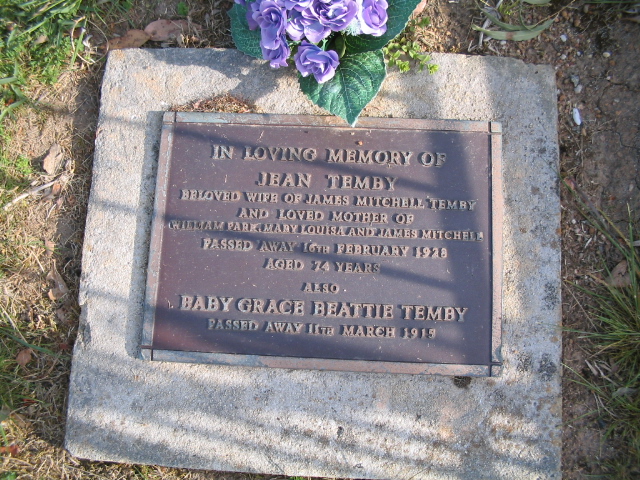
William and Beatrice lived on the family farm and  Beatrice died September 8, 1950, aged 75, whilst William died on August 18, 1957 aged 78. The last few years of his life he was living in Surrey Hills. (9) Did they have children? The plaque on Jane Temby's grave at Bunyip also lists -  Baby Grace Battie Temby passed away 11 March, 1919, which is their daughter, but I can't find a reference to either her birth. (10)


Death notice of William Temby, 1957
The Age, August 19, 1957,p. 11,  from newspapers.com


The Breach of Promise case
The case brought by Charlotte Ewen against William Temby was held in the County Court in Melbourne in November 1911.

From The Age of November 18, 1911 (see here)
BREACH OF PROMISE CASE. YOUNG WIDOW AND FARMER. £1000 CLAIMED
.

An action for breach of promise of marriage was commenced in the County Court yesterday before Judge Johnston and a jury of six. Plaintiff was Charlotte Flavelle Ewen, formerly of Garfield, but now of Horsburgh-grove, Malvern, widow, and defendant was William Park Temby, of Bunyip, farmer. Plaintiff claimed £1000 damages, included in which was £40 as special damage for the costs of trousseau.

Mr. Duffy, K.C., and Mr. Stanley Lewis (instructed by Messrs. Backhouse, Skinner and Hamilton) appeared for plaintiff; and Mr. Meagher (instructed by Mr. Davine, of Warragul) for defendant.

The formal defences were a denial of any breach of promise; that the engagement was broken by plaintiff; and, further, that it had been agreed between the parties that the marriage should be postponed for three months.

Plaintiff gave evidence that after the death of her husband she went to live with her father and mother at Garfield, in the Gippsland district, her father being a farmer there. She became acquainted with defendant, and they were engaged to be married. That was about a week before Easter of the present year. On Sunday, 30th July, she went with her father to see defendant, who was slightly ill. He lived with his mother and sister about six miles away. After afternoon tea his mother and sister left the room, saying it was time to milk the cow. Her father went on the verandah for a smoke. 

Then defendant blurted out: "Look here, I am not going to marry you, Lottie." 
She replied: "Goodness gracious, for what reason?" She called her father into the room, and, after a short explanation, he promised to come up to her father's house and give an explanation. As he did not come on the Tuesday, 1st August, she waited until 9th August, when she wrote to him. He replied in a letter in which he said that she herself broke off the engagement whilst he had only desired it should be postponed. There was no truth in that assertion.

Mr. Duffy: Did defendant ever say any thing about himself? -Yes, he told me he had £4000. Mr. Meagher: Did that attract you? Witness No.
This was a love match? - Yes. I have been a widow for twelve months, and have a child. Before I was married to my late husband I was engaged to a Mr. Chick. I broke that engagement off. I was 18 years of age then, and am 24 now.
Since Mr. Ewen's death have you been engaged to anyone else? - Yes, little over three months after my husband's death I became engaged to a Mr. Cooper, of Glenferrie. Was it "a love match" with all three of them? - Yes. I also broke off that last match. I was engaged to Mr. Cooper just before Christmas, and freed myself on New Year's Day. Were you heartbroken when you broke it off? - No, Mr. Cooper did not complain that I was too fond of walking out with other young men.
Why did you break off your engagement with him? - Well, he asked me such a lot of questions about the furniture I had that it was apparent that he was not marrying me for love, and so I gave him up.

Did your husband leave you about £100? - No, about £300. There were no debts to pay. I know a young man named Arthur Dorey. I took him out twice for a drive whilst he was staying at my father's place. I have known him since I was a child. I was never engaged to him. Does that list include all your lovers? - Yes. I was very fond of Temby; but his conduct cured me. I cannot say I hate him.

Did you ever tell anybody that you thought Temby had a lot of money, but that it turned out to be his mother's? - No.
Did you not say that you had had a narrow escape? - Certainly not. There was no suggestion by defendant that the marriage should be postponed. I should have been glad to have waited, as I did not want to be married so soon after the death of my husband. I was utterly surprised when he broke the affair off.
He didn't embrace you or kiss you at that interview? - No, he did not; we used not to spend our whole time in doing that kind of thing. (A laugh.) 
I asked him to come and see me on the following Tuesday to explain his despicable conduct. At the close, of the interview he took me by the hand and said, "Good-bye, old girl."
You wrote him an indignant letter? - I was very much upset when I wrote that letter. My indignation had been growing all the week. You said in the letter, "Knowing what I do now of you and your mother, I thank God for what I am saved from." So you are glad you did not marry him? - Yes.

Then don't you think you ought to pay us something for getting rid of a bad bargain? - Oh, dear no.
You complain of "mean, low, cunning, despicable cold cruelty" - a fine, set of adjectives? - Yes.
Again - "You are a low down lot," "mother's crying Willie." That was defendant? - It was.
"How you have deceived me and my parents" - Was that about him not having £4000? - Yes. I do not say he is a good mark for damages. I was willing to accept £500 to compromise the case. All I want is to have my character cleared. When a man gives up a woman in the way he did me, some people might infer a lot. What about when you gave the other poor fellows up? - Oh, that don't matter.
(A laugh.) I want to punish him for the way he treated me. What's sauce for the gander is sauce for the goose? - Not always. That's women's rights with a vengeance. Ought you not to be punished for giving up the other men? - No, certainly not.

You wrote that you "would be glad to get away from such a miserable crew"? - Yes; that's the man's mother, his sister and himself. I have felt thankful since that I got away from them. I think I had a narrow escape. You had a ring and a watch which were given to you? - Yes, I have them now. I did not send them back again. I think I was entitled, to keep them in the circumstances.

Alfred Paynter, father of plaintiff, stated that he visited defendant's place. The latter said there were 125 acres, worth £30 an acre. There were 75 head of cattle, and he had a good banking account. The land and cattle, he said, were all his.

Mr. Meagher, in opening the case for defendant, alluded to plaintiff as "an attractive, but business-like and dangerous young widow." In "The Pickwick Papers" the elder Weller told his son Samuel to "beware of widows." That advice remained good to the present day. No doubt defendant fell in love with this widow and proposed marriage. In the circumstances no one could blame him. Being attacked with influenza, however, he wanted the marriage postponed. Plaintiff demurred to the proposal. This was first made on the Saturday. On the Sunday the father came to defendant's house with his daughter. The marriage was ultimately only broken off by the extraordinary and abusive letter plaintiff wrote to him.

Plaintiff thought defendant was worth £4000. When she found that he had very little money and would not be much of a "catch," she was glad of an opportunity of breaking off this engagement, as she had done others.

Defendant gave evidence that he was 33 years of age, and was a village settler. He had 53 acres of leasehold land. The value was about £13 per acre. He had a little machinery and about £5 in the bank. He never told plaintiff's father that he possessed £4000. He became engaged to plaintiff. She was given a ring of the value of £20, and a watch worth £8 8/. Some alterations were made to his mother's house to fit it for the reception of his proposed wife. During June and July he had a cold, and contracted a tender throat. In consequence of this, he felt low and miserable. He spoke to plaintiff, saying - "Your first husband started with a sore throat, didn't he?" She said, "Yes." He said, "I think we had better postpone the marriage. She replied - "Oh, no, its going out at night that has given you a sore throat. When we are married you won't be running out after me." To that he (defendant) replied. "Well, I shall be glad when it's all over. " (A laugh.) 

This was on the Saturday, and on the following day plaintiff and her father came to the house. He (defendant) then suggested that the marriage be postponed for three months. Plaintiff said, "I won't put it off. I would sooner break it off." His (defendant's) mother came into the room and said, "Lottie, if you drive him into a corner I'll cut him off with a shilling." Plaintiff said, "Does your mother own this place? " He said, "Yes." She answered, "Three women cannot live here, and I won't." Plaintiff further complained about him having spoken to her about going out with Dorey. She put her head on his shoulder and he kissed her. She said she was very disappointed about what had happened. Plaintiff's father came into the room and asked him to "pray over the matter." His last words were - "Good-bye, old girl; any way, we won't get married in September," The match was not broken off - only postponed. He was still fond of her. They had had no quarrels. His mother had not been opposed to the marriage. He was dreadfully upset at receiving the abusive letter from plaintiff, and went for a trip to New South Wales.

Apart from that letter, he had always regarded plaintiff as being a really nice young woman. At this stage the further hearing was adjourned until Monday.

From The Age of November 21, 1911 (see here)
BREACH OF PROMISE. YOUNG WIDOW AND FARMER. DAMAGES ASSESSED AT £50.

[Article commences with a summary of the people involved, the legal team and a repeat of the formal defences]

The defendant gave evidence on Friday, and he was now cross-examined by Mr. Lewis. He admitted writing the following letter to plaintiff: -
Dear Miss Ewen, - I received your letter dated 9th August. You know very well I did not break off our marriage. You did yourself. I only wanted to put it off, as I was not well enough, and in no position to marry or go to the expense you wanted me to go to. After reading your letter, with its insulting remarks to my mother and family, I, too, thank God you took the course you did.
Mr. Lewis: Are the statements in that letter true? Witness: Yes, they are true. Plaintiff broke off the engagement herself. I regard her letter as being that of a vindictive woman. It was just a letter of abuse.

What is the meaning of this sentence in your letter- "I decline to go to the expense you want me to"? - Oh, she wanted things I could not give her. She also wanted a longer honeymoon than I could afford to take. I was not in a position to marry at the time. Why? - I had suffered losses because of Irish blight in the potato crop. Then, on account of my illness I was advised to go away on a holiday to New South Wales. Did you ever say that the marriage was broken off by mutual consent? - I never said that. I said that plaintiff broke it off.

Jane Temby, defendant's mother, said that on the afternoon of the quarrel she heard plaintiff say - "I will break it off, but not postpone it." Mr. Lewis: Did you part as good friends? Witness: Oh, yes.
Then why should she have written such a letter?- I cannot say. I was astonished. Now, was not your son frightened to see her? - No ; he would be no son of mine if he was frightened to see any woman. The fact was that he was not well enough to get married.

Annie Park (11), of Garfield, said that, in regard to the trousseau for which plaintiff was charging, plaintiff had worn one of the hats, and on the present occasion was wearing one of the dresses.

Elizabeth Flett, of Bunyip, married woman, said that plaintiff had informed her that the engagement with Temby had been broken off, because he had deceived her people about the property. She also said that she was glad that she was not going to live at the place, as she did not think that she would get on with Temby's mother. Plaintiff, during the conversation between them, said : I wouldn't have him now not if he were hanging with diamonds." (A laugh.)

His Honor, in summing up, said that up to a certain point both parties were agreed. There was no dispute about the fact that plaintiff became engaged to defendant about Easter of last year. Both sides said there was not a ripple on the water of their happiness up to July last. Before that time there was no suggestion of a breach, of a postponement of the marriage. According to plaintiff, however, on Sunday, 30th July, he informed her he was going to break off their engagement. He promised he would go to plaintiff's residence on the following Tuesday to explain why, but he never went. Plaintiff then wrote a letter, about which there had been much discussion, and defendant wrote a reply. Defendant's version was that the marriage was merely postponed, and that on the Sunday all parties left on good terms. It was for the jury to judge which story was true. 

Did plaintiff break off the engagement herself in that letter, or was it merely written because a woman whose feelings had been outraged desired to tell a man what she thought of him? If the jury believed defendant's view, there would be no case made out by plaintiff, therefore no damages to award. If plaintiff's view were accepted, the jury must take into consideration what she had lost by the marriage, and give her such reasonable damages as in the circumstances they might deem fit. The jury returned a verdict for plaintiff,and assessed the damages at £50, with costs. A stay of proceedings was granted for seven days.

Footnotes:
(1) Index to Victorian Births, Deaths and Marriages; The Age, July 4, 1908, see here
(2) Shire of Berwick Rate Books; there are two 1914 Electoral rolls on Ancestry and they are listed at 1 Wigton Street, Ascot Vale in one and at  Alexander Avenue, Elsternwick in the other.
(3) Index to Victorian Births, Deaths and Marriages; Herbert's death notice - The Argus, June 27, 1910, see here.
(4) Index to Victorian Births, Deaths and Marriages; Electoral Rolls; Charlotte's death notice Lismore Northern Star, November 18, 1918, see here.
(5)James Temby married Jane Park on may 16, 1877 at Golden Lake (near Scarsdale. Birth of children - Index to the New South Wales and Victorian Births, Deaths and Marriages;  Death notice of little James  - Ballarat Courier, April 7, 1883, see here; Mary Louisa Temby married William Alcorn in 1912 and she died in Shepparton in 1933 aged 52. Her death notice in The Argus of August 2, 1933 (see here) lists her as the beloved wife of William and beloved mother of Jean, Beatrice and Grace, and loved sister ow Will and sister-in-law, Beatrice. Jane or Jean Temby died February 16, 1928 


Temby - Park marriage, 1877
Ballarat Courier, May 18, 1877 http://nla.gov.au/nla.news-article207821755

(6) Creswick Mine Disaster - The Argus, December 15, 1882, see here; Benalla North Eastern Ensign, December 15, 1882, see here; Creswick Museum https://www.creswickmuseum.org.au/exhibitions/the-mining-room/australasian-mining-disaster/ 
(7) The Shire of Berwick Rate books don't show the exact year they took up the land; sometimes the Koo Wee Rup Swamp allotments took a few years to appear in the Rate books, however they do appear in the 1899/1900 book, which was the year William turned 21, so this may actually have been the date of their arrival.
(8) William and Beatrice marriage The Argus, March 21, 1914, see here; Arthur's death notice The Argus, September 11, 1903, see here.
(9) Beatrice death notice The Argus, September 11, 1950, see here; William death notice The Age, August 19, 1957. 
(10) Baby Grace Beattie Temby - I can't find a reference to either her birth or death in the Index to Victorian Births, Deaths and Marriages.


Temby plaque at  Bunyip Cemetery 

(11) Witness Annie Park was the wife of George Park, a blacksmith of Garfield. Jane had a brother George, as you can see from her death notice below, so this was possibly him.

Jane Temby's death notice, 1928

Wednesday, July 10, 2024

Aeroplane VH-UMG makes a forced landing at Koo Wee Rup, December 1933

On December 14, 1933 an aeroplane, Tasman VH-UMG, was forced to land in a paddock at Koo Wee Rup, due to high winds. The Sun News-Pictorial of December 15, 1933 reported on the incident -

TASMANIAN AIR LINER IS FORCED DOWN BY STORM. 
Lands in Heavy Rain at Koo-wee-rup; Plane Undamaged And None Hurt
By a Special Correspondent

Koo-Wee-Rup, Thursday. - Driven back by a storm over Bass Strait on its flight from Melbourne to Tasmania today, the air liner, Tasman, with two pilots and a boy passenger, was forced to land in heavy rain at Koo-wee-rup at 1 p.m.

No damage was done to the liner and the pilot landed so adroitly that not even the boy passenger suffered the slightest effect. Rain fell all the afternoon, compelling the liner to remain overnight. The landing was made in a large sheep paddock, owned by Mr. P. Einsedel. Residents heard the engines of the liner, which was invisible behind thick, low clouds, droning for 30 minutes while the pilot searched for a landing place. The liner left Melbourne at 9.30 a.m. The pilot said he had travelled 250 miles since passing over Koo-wee-rup at 10 a.m. on the outward flight.
(1)

The next day the Sun News-Pictorial gave an update of the story -
The Hart air-liner, Tasman, which was forced to descend on Thursday at Koo-wee-rup, after endeavoring to fly from Melbourne to Tasmania during the gale, took off yesterday at 7 am. without assistance, and returned to the aerodrome at North  Essendon. The aeroplane left again for Launceston at 9.10 a.m. with four passengers, including the boy who was the original passenger, and arrived at Launceston at 1 p.m. (2)


Tasman, VH-UMG, forced landing at Koo Wee Rup, December 14, 1933
Sun News-Pictorial, December 15, 1933 http://nla.gov.au/nla.news-article276126272


The Koo Wee Rup Sun of December 21, 1933 had this report  -

55 Miles an hour gale
Heavy rain and a southerly gale which reached a velocity of 55 miles an hour caused much damage last Thursday. Huge seas - the largest remembered - ran in Port Phillip Bay. In many Melbourne suburbs trees and boardings were blown down, and streets were flooded. In the country the rain done more damage to crops and will delay harvesting. At Kooweerup 154 points of rain from fell 9.00 a.m. Thursday to 9 a.m. Friday. For the second time within a few weeks the pilots of aeroplanes carrying mails and passengers across Bass Strait deemed it inadvisable to make the crossing. On Thursday one landed at Kooweerup on Mr C. Einsedel's property. The plane was tethered by Mr T. Burton, of the Kooweerup Motor Garage, and the following morning journeyed back to Melbourne. (3)


The plane landing at Koo Wee Rup
Koo Wee Rup Sun, December 21, 1933 p.4

VH-UMG, the air liner, was owned at the time of the incident by Hart Aircraft, and had previously been owned by Australian National Airways. A correspondent to The Age, by name of B. Clayton, wrote in March 1931 - 
Australian National Airways Ltd have five planes in operation at present, the names and registration letters of which are as follow:- Southern Moon, VH-UMI; Southern Sky, VH-UMH; Southern Cloud, VH-UMS; Southern Star, VH-UMG; Southern Sun, VH-UNA. The Southern Cross (VH-USL) will be put into commission at a later date. They can each accommodate ten passengers, but the usual number is eight or nine. The machines cost £9000 each. (4)  

In February 1933, Australian National Airways were in liquidation and their planes and other infrastructure were advertised for sale by tender, including VH-UMG. (5) It was sold to Hart Aircraft Service who were based at Essendon Airport. They changed the name of the plane from Southern Star to Tasman. Hart Aircraft operated the Bass Strait service from 1933-1934. VH-UMG crashed at Mascot Airport in November 1936 and was written off. (6) You can read about Hart Aircraft in the Tasmanian Aviation Historical Society article by C. Byrne, here  


Australian National Airways invites tenders for VH-UMG and other planes


VH-UMG, the plane which landed at Koo Wee Rup, in happier times


Hart Aircraft Service, Essendon Airport, 1930s.
The plane on the left is VH-UMH.
Early view Essendon Airport. Photographer: Raymond W. Garrett.
State Library of Victoria Image H98.129/12

Footnotes
(1) Sun News-Pictorial, December 15, 1933, see here.
(2) Sun News-Pictorial, December 16, 1933, see here.
(3) Koo Wee Rup Sun, December 21, 1933 p.4
(4) The Age, March 13, 1931, see here. 
(5) The Age, February 27, 1933, see here