Saturday, January 19, 2019

What happened in Koo Wee Rup in 1914

This what happened in Koo Wee Rup and surrounding areas, 100 years ago in 1914. These references are from various newspapers available on Trove http://trove.nla.gov.au/newspaper

1914 started off with an attempt to start a soccer league in the area. The Lang Lang Guardian reported on January 14, that Mr Frank Garwood of Modella wanted to start a British Association Football League. The League would cover the area between the two Railway lines - Koo-Wee-Rup to Lang Lang and Garfield to Longwarry.  There was already at least one team practically formed at Modella. Mr Garwood urged anyone interested in playing the English soccer game (NOT rugby, as he emphasized) to contact him.
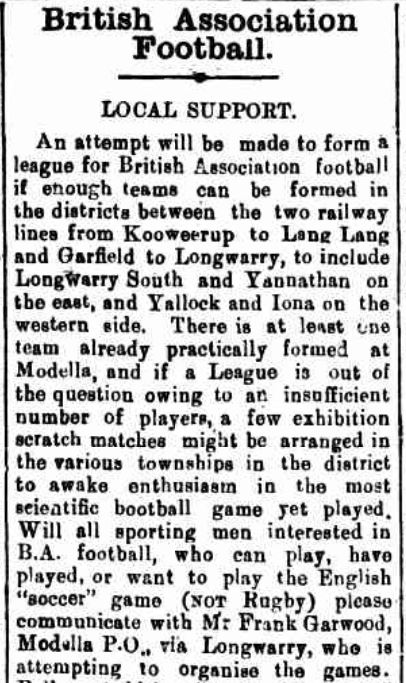
Lang Lang Guardian January 14, 1914
Read the full article here - http://nla.gov.au/nla.news-article119510085

The Weekly Times reported on February 21, 1914 on Mrs Agnes Hudson’s will. She left Real Estate worth £5595 and personal property of £1634.  Mrs Hudson had died on December 10, 1913 aged 86. She owned The Grange, the oldest extant house in Koo Wee Rup. 1914 also saw the death of David Mickle (her son by her first marriage to Alexander Mickle), who was born in 1858. His death was reported in The Argus of November 25.

On March 1, the Lang Lang Guardian reported that the erection of the Lubecker Steam bucket dredge on the Lang Lang River was nearly complete. The dredge had been imported by Public Works Department Engineer, Carlo Catani, from Germany at a total cost of £4716. It spent a few years working on the Lang Lang River and when it finished there in 1916 it moved on to work on the Main Drain.

On April 8, the Lang Lang Guardian reported that 92 crates of rabbits, each containing 24 pairs was sent off from the Lang Lang railway station. That’s 4,416 rabbits! No wonder the paper reports that it was now an important industry!

Lang Lang Guardian April 8, 1914

The Lang Lang Guardian reported that on April 22 that a 3 lb (1.3kg) potato was on display at Lang Lang, having recently been displayed at Koo Wee Rup.

On April 23, the Bunyip Free Press reported that a Caledonian Society had been formed in Koo Wee Rup. The inaugural meeting was attended by members of the Bunyip and Cranbourne Caledonian Societies. The purpose of the Society was to promote Scottish culture. Mr R. Laidlaw was elected Chief and the Chieftains were J.Hudson (the son of the aforementioned Agnes Hudson), H. Beattie, Mr Christie and Mr Bethune. A Highland Gathering was planned for December 28 with prizes for Highland dress, piping and dancing, tossing the caber, throwing the hammer and putting the stone (which I presume is the forerunner of the shot put) and tossing the sheaf.

On June 24 the Lang Lang Guardian  reported that the old Yallock Mechanics Institute was being demolished. The replacement Hall was finished a few months later and officially opened on September 30. The Hall was 26 feet  by 50ft, with a 9ft stage; there was a supper room which was 26ft by 10ft and two other rooms each 20ft by 12ft.  These last two rooms were made from the timber of the old hall. The dance floor was built of Tasmanian oak.  The cost of the hall was £300. The opening ceremony consisted of a concert, then supper at 11.40pm followed by dancing. The Hall (or part of it) was moved into Bayles in the early 1930s (Report of the opening of the Hall was in the Lang Lang Guardian, October 7 1914).

Also in the news - John Colvin was given the contract to enlarge and renovate the Koo Wee Rup Hall (South Bourke and Mornington Journal, September 3, 1914).   In October, the Bill to authorise construction of the Koo Wee Rup to McDonalds Track Railway was passed - construction began in August 1915 (The Argus, September 22 1914). In November , the  additions to St John’s Catholic Church were opened. (The Argus, November 2, 1914)

And finally my favourite report from 1914 was from the Lang Lang Guardian of October 28. Reverend Butchers, the Presbyterian Minister from Cranbourne, was driving to Koo Wee Rup to conduct the wedding of Mr A.C Colvin and Miss Johnston, unfortunately he was thrown from the vehicle and his collar bone was broken and his shoulder dislocated. Lucky for everyone, one of the wedding guests found Rev Butchers on the road, drove him home and then secured the services of the Church of England Minister and brought him out to perform the wedding. Weddings were much simpler in those days. Mr Colvin had started a cycle shop in the town in 1909


Lang Lang Guardian October 28, 1914

What happened in Koo Wee Rup in 1913

This is a look at what happened in Koo Wee Rup in 1913. In retrospect, 1913 was the last normal year for many years for Australians as 1914 was the start of the Great War. After that, for the next four years, communities like Koo Wee Rup devoted most of their time and energy to fundraising and activities to support the war effort. The community also had to deal with their young men going away to fight and then the sadness when they were killed or injured. So here’s a look at 1913 - a year of optimism and community spirit.

In March, the Presbyterian Church was lined with Wunderlich metal plates, a very modern choice of building material. St Georges Anglican Church held their first ‘Fruit and Flower’ Show on April 28 at the Hall. The event was enthusiastically supported by the public and the range of exhibits was of good quality. The exhibits encompassed 271 categories of fruit and vegetables. The evening finished with a concert and over £20 was raised for the Church funds. (Lang Guardian March 12 1913 and April 30 1913)


Lang Lang Guardian March 12, 1913

On May 3, the local football started with five teams - Koo Wee Rup, Yannathan, Lang Lang, Yallock and Tooradin. (Lang Lang Guardian May 7, 1913)

Also in May, a skeleton was found in a gravel pit just outside the town. It was believed to be that of an Aboriginal. The police were called and the skeleton was sent to the Coroner’s Office. There was no report to what happened to the skeleton after that. (Lang Lang Guardian May 21, 1913)

The Argus of June 16 reports that the long promised dredge has arrived at the Lang Lang River. This was the Lubecker Steam bucket Dredge, imported by Carlo Catani, Chief Engineer of the Public Works Department, from Germany at the total cost of £4,716. After it worked on the Lang Lang River it was moved to the Swamp and worked on the Main Drain, Cardinia Creek and the Yallock outfall drain. All that remains of this grand machine is a set of wheels on display at the Swamp lookout tower, on the South Gippsland Highway.  It was fortunate that the dredge arrived when it did, because once war was declared in August 1914, it would have been impossible to import German machinery.

Also in June, skating was held at the Hall to raise money to line the walls and to install an ‘up to date’ acetylene light plant. The report is below.

Lang Lang Guardian June 25 1913

In September, £900 worth of improvements was carried out at the Koo Wee Rup Railway station including improving the level crossing and the railway yards. (Lang Lang Guardian September 17, 1913)

In October, Archbishop Mannix carried out confirmations at the Catholic Churches at Koo Wee Rup and Lang Lang. (The Advocate, November 1 1913) The same month, a local Cricket Association was formed which consisted of teams from Koo Wee Rup, Modella, Lang Lang, Tooradin, Yallock and Yannathan. The first match was played November 1, 1913.  (Lang Lang Guardian  October 29, 1913)

There were reports in various papers of floods in November -  the Main Drain overflowed at the bridges, 2,000 aces of potatoes were inundated and  the school ground at Five Mile School was under water amongst other damage. Carlo Catani visited the area and was reported as saying that the reports of damage had been greatly exaggerated. (Read more about this, here) So as we have seen over recent years there was a gap between the reality of the floods and the rhetoric of the government (or Melbourne Water) – so no change there.

On December 10, Swamp pioneer, Agnes Hudson passed away, aged 86. Agnes was born in Scotland and came to Victoria with her first husband, Alexander Mickle. They settled at the Yallock Station. In 1861, Alexander died and she was left a widow with two young children and was eight months pregnant with their third child.  She later married Andrew Hudson and had two more children. After Andrew died in 1888 she moved into The Grange, in Koo Wee Rup. This house, off Sybella Avenue, still remains. (Mrs Hudson's obituary is in the Lang Lang Guardian December 17, 1913)

Finally, my favourite report for 1913 is this one - a cheese maker from Koo Wee Rup wrote to the Commonwealth Offices in London seeking their help to find a wife. His ‘golden girl’ had to be a ‘tall, fair lump of a Protestant’. A not very romantic description and sadly, I don’t know whether he turned out to be lucky in love.  It was in the Adelaide Mail, from October 18 1913

Adelaide Mail October 18, 1913

Friday, January 18, 2019

What happened in Koo Wee Rup in 1912

This is a look at what happened in Koo-Wee-Rup and surrounds, one hundred years ago, in 1912. These references are taken from various papers on-line at http://trove.nla.gov.au/newspaper

In January, Mrs McKenzie, who had been Head Teacher at the Koo Wee Rup State School for the previous 22 years was entertained in the Hall, prior to her departure to Moolart, where she had been transferred. Over 100 people attended the function and were entertained with performances by her previous students amongst other amusements. Mrs McKenzie was presented with a book of Shakespeare’s poems and a purse of sovereigns (South Bourke & Mornington Journal, January 25 1912)

The South Bourke and Mornington Journal reported that on Saturday, February 17 the Pakenham Magistrates Court was crowded with onlookers to hear the case between two Koo-Wee-Rup residents, William Himbeck and Matthew Killeen. Himbeck had accused Killeen of assault and using bad language. Several witnesses were called from both sides and the evidence given was very contradictory. The paper reports that some witnesses heard very bad language indeed, whilst others heard only the pure Australian accents undiluted with profanity. The Bench found Killeen guilty and fined him £1 for the assault with 28 shillings in costs and five shillings for the bad language with 20 shillings in costs. So all up that was £3 and 13 shillings; a fair bit of money at the time as the average wage for a factory worker was about £3 per week and for a man employed under the Rural Workers Award the weekly wage was £2 10 shillings.

The South Bourke & Mornington Journal of July 4, reported that a concert was held in the Koo Wee Rup Hall with 300 in attendance to raise funds to build a shelter shed at the School. £16 was raised and a dance was held after the concert. The shelter shed was built by John Colvin and completed in October.

On July 5, which was Arbor Day, nearly all the residents of the district turned up at the State School with their horses, carts and spades and planted 50 trees at the School and they laid out the teachers garden and the school garden, planted hedges and erected fences. The ladies of the district provided lunch and afternoon tea. The report goes on to say that a new school building is badly needed as the existing one is too small to accommodate the sixty children.  A new Koo Wee Rup State School building was erected in 1915 and burnt down in May 1950.  The original building had been erected in 1884 between Koo-Wee-Rup and Bayles and relocated into Rossiter Road in 1910 relocated again in 1919 to become the Dalmore East School (No.3925) later known as Island Road School. Island Road School closed in 1974 and the building was relocated back to Koo-Wee-Rup, and became part of the Primary School. (The Arbor Day event was reported in the South Bourke and Mornington Journal on July 11, 1912)

On July 16, the School was closed by order of the Health Officer, Dr Harkness, as three children were suffering from diphtheria. Diphtheria could be fatal and in 1912 257 Victorians died of the disease. (Report from the South Bourke and Mornington Journal of July 25, 1912.)

In September, the Railway promised to erect a small sheep and cattle yard at the Station. Locals had complained that the nearest livestock loading yards were at Monomeith, five miles by road. (The Age, September 4, 1912)

The Age September 4, 1912

In October, Yannthan defeated Koo-Wee-Rup in the Lang Lang District Premiership League final – Yannathan scored 4 goals and 11 behinds and Koo-Wee-Rup 3 goals and 9 behinds. (The Argus, October 2 1912)

A report in the South Bourke and Mornington Journal on October 10, said that the London Bank purchased the land on which their premises stood. Whatever their original premised were, they were obviously demolished as the existing building (the A.N.Z Bank) was built in 1919.

On November 26, The Argus reported that the passenger platform at the Koo-Wee-Rup Railway Station was lengthened to accommodate the new longer trains and in December a new train was added to the timetable - a Goods train with a passenger carriage attached.  This would leave Koo-Wee-Rup at 6.50am daily and meet up with the Warragul train at Dandenong from where it would leave at 8.57am, eventually arriving in Melbourne at 10.04am. In comparison to today, three hours to get into town isn’t too bad. In 1912 you would have had time for morning tea at the Dandenong Railway Station Refreshment Rooms, which had been built at a cost of £750 in 1908 and there would have been a clean, functioning toilet at the Station - so compared to getting stuck on the Monash Freeway for hours, it sounds like a great alternative. (The report on the extra train comes from the South Bourke & Mornington Journal of December 5, 1912)