Tuesday, July 11, 2023

Pub crawl in 1918 leads to licensing prosecutions at the Bunyip Police Court

The Bunyip and Garfield Express of October 4, 1918 had this following interesting account of a pub crawl by four lads -  Frederick Sippo, Hugh Murdoch, Stephen  McMillan (spelt as M'Millan in the article) and George Schmutter which saw the licensees of three hotels end up in the Bunyip Police Court on licensing charges. 

Bunyip Police Court. Wednesday, Oct 2, 1918.
Before Messrs Tanner, P.M., and a’Beckett and Barker, J.’sP.
Licensing Prosecutions

Inspector M’Loughlin proceeded against Edward Augustus Dreier, licensee of the Iona Hotel, Garfield, for serving 3 persons, apparently under the age of 18 years, with liquour, on 3rd August last.
Mr Davine, for Mr Dunn who was ill and unable to be present, appeared for the defendant, who pleaded not guilty.
Permission was given to the inspector to amend the summons, as it was since found that one of the persons supplied was over 18 years.
Frederick Sippo, said on the day in question he went to the hotel at Garfield, where he had a few shandies; the drinks were supplied by Mrs Dreier, who never asked anything about his age; he was born on 10th Nov, 1901, and knew the difference between a soft drink and beer, as he had drank beer before.
In reply to Mr Davine witness said he told defendant prior to that date he was over 18.
Hugh Murdoch, aged 16, said a lady whom he did not know served them, and he had never previously told Drier he was over 18.
Stephen M’Millan, aged 18, also gave evidence as to being served, and that Dreier made a practice of keeping boys out of his hotel.
The defendant, who was away in the city on this day, said he always made it a practice of inquiring about young fellows ages, and had asked them to leave the billiard room if not 18. Mrs Dreier was in charge while he was away but he could not say if he asked their ages in the presence of his wife, but the three youths had previously told him they were over 18.
The Bench said the information would be dismissed, as defendant had evidently put his foot down on this matter by taking every precaution.

A similar charge was preferred against Henry Wilson, licensee of the Gippsland Hotel, Bunyip, for serving a person under 18 years of age on the same date.
The youth Sippo said he went into the hotel in company with G. Schmutter, who called for two drinks; he had a shandy, but had never had drink there before.
To Mr Davine (for Mr Dunn) – he was standing near the window in the bar parlor, so that the licensee did not have a full view of him; he knew now that Mr Wilson would not supply anyone under 18, and heard him refuse to serve Murdoch and M’Millan.
George Schmutter said he called for 2 drinks and Sippo had a shandy; Sippo would not be visible to the licensee when he served the drinks.
Without calling any evidence for the defense, the case was dismissed.

Inspector M’Loughlin v Thos. Stacey a similar charge to the previous one.
Mr Backhouse for the defendant.
Sippo again said he went into the bar with Schmutter and had a shandy, but he wouldn’t contradict Tom Stacy if he swore he refused to serve them.
G. Schmutter said he did not suppose Tom knew who he was getting the drinks for as there were several about; he remembered going to the side window for a bottle of wine.
Mr Backhouse said the licensee, who had never had a charge brought against him for over 20 years, had no knowledge that the lad Sippo had been served with liquour.
Thos Stacey, jun. said he refused drinks to a crowd and never at any time did he serve Sippo with drink; he only supplied Schmutter with a bottle of wine.
The licensee and R. M’Namara gave evidence that they were playing cards in the room behind the bar, and heard the previous witness refuse to serve them.
The Bench said they were satisfied that the youth had not been served, and dismissed the information.


In a Koo Wee Rup Sun article of this case it concluded with a pun. They reported that as Frederick Sippo was involved in all cases he was the youth who should not be allowed to sip drinks in a hotel (1).

I have written about the Iona Hotel at Garfield here and the Gippsland and Railway Hotels at Bunyip, here
.................................................................................

Who were these boys?
Frederick Sippo. Frederick, born November 10, 1901 at Bunyip South, as Iona was then called, and was the son of Simon and Olive (nee Warren) Sippo. Listed in the Electoral roll at Iona, Simon was a contractor and bridge builder. 


Simon Sippo bridge building in a flood

Olive died April 11,  1929, at the age of 65,  and her death notice lists their children as Winifred, John (Jack), Ollie, Annie, Leslie, Charlie, Joe, Fred, Alfred and Ernie. The family were then living in Seddon, and she is buried at the Footscray Cemetery along with Simon, who died a few weeks later at the age of 68. Also in the grave is Frederick, who died at the Melbourne Hospital at only 32 years of age on September 3, 1934. (2).


Death notice of Frederick Sippo


Hugh Murdoch. Hugh James Murdoch was born in 1902 in Balranald, NSW to George Petrie Murdoch and Emma Rose Parker, who had married in Balranald in 1897. Hugh was the brother to Arthur, Mary, Allan, Lily, Stanley, Archibald and Alice.  George opened the Cora Lynn General Store in 1907 and operated it until 1922, and had also opened the Bayles General Store in 1921. You can read about the Cora Lynn store, here and the Bayles store, here.  Hugh followed in the family trade as he is listed in the Electoral rolls as a shop assistant at Narre Warren, and later as a farmer, also at Narre Warren.  Hugh married Elizabeth McMillan in 1924 and died August 16, 1994, aged 92. Elizabeth died in 1985 aged 82 and they are buried at the Bunyip Cemetery. (3)

The death notice of Hugh's wife, Elizabeth.
The Age June 19, 1985, p. 31 newspapers.com


Stephen McMillan. Stephen was the brother of Elizabeth, Hugh Murdoch's wife. They were the children of Robert James and Bridget (nee Guthrie) McMillan. The births of Stephen and Elizabeth were registered in Dean in 1900 and 1903 and the Electoral rolls list them at Bullarook, near Ballarat. They later moved to a farm at Garfield. Bridget died in 1935 aged 70 and Robert in 1932, aged 68 and they are buried at the Bunyip Cemetery. Stephen married Sophia Joyce Baxter in 1922 and are listed in the Electoral Roll on farms at Cora Lynn and then Koo Wee Rup Road, Pakenham.

On June 4, 1941 Stephen enlisted in the Australian Army (SN VX57181). He said his birthday was December 26, 1902, so it seems he took three years off his age, and given that most men who lied about their age kept the actual day and month, he was most likely born December 26, 1899.  He served in the Middle East, but was discharged January 4, 1943 on medical grounds. Stephen died in Frankston in 1960, aged 60 and he is buried at Frankston Cemetery. Sophia died in 1987 in Mount Martha aged 87. (4)

Death notice of Stephen McMillan
The Age, July 26, 1960, p 16. newspapers.com

George Schmutter. George was born at Bunyip South (Iona) in 1895, the son of William and Mary Ann (nee Hannington) Schmutter. This makes him about 23 when the pub crawl took place. However,  the 1919 death notice of Mary Ann and the 1932 death notice of William both list their children as Henry, William, Agnes, Florence and Jack, with no mention of  a George. There is  a George Schmutter listed in the Electoral Rolls from 1916, the year George would have turned 21, with the occupation of labourer and address Iona, so that is likely to be him. George Schmutter married Ella May Chadwick in 1925 and they are in the Electoral Roll at Iona or Vervale up to at least 1949 and from the 1954 Roll they are living in Parramatta in New South Wales, where his occupation is a gardener. George died in South Melbourne in 1963, aged 68, and Ella died in Parramatta in 1977. I was unsure whether this fitted together, then I found Ella's death notice in the Sydney Morning Herald and George is called Jack, so that pulls all the pieces together, and confirms that George is the Jack listed in his parent's death notices. Then as double confirmation, Find a Grave has a photo of their memorials at the Rookwood General Cemetery in Sydney, and they have his name listed as George John Schmutter, hence the diminutive, Jack. (5).


Death notice of Ella Schmutter
Sydney Morning Herald, September 30, 1977 p.19. newspapers.com
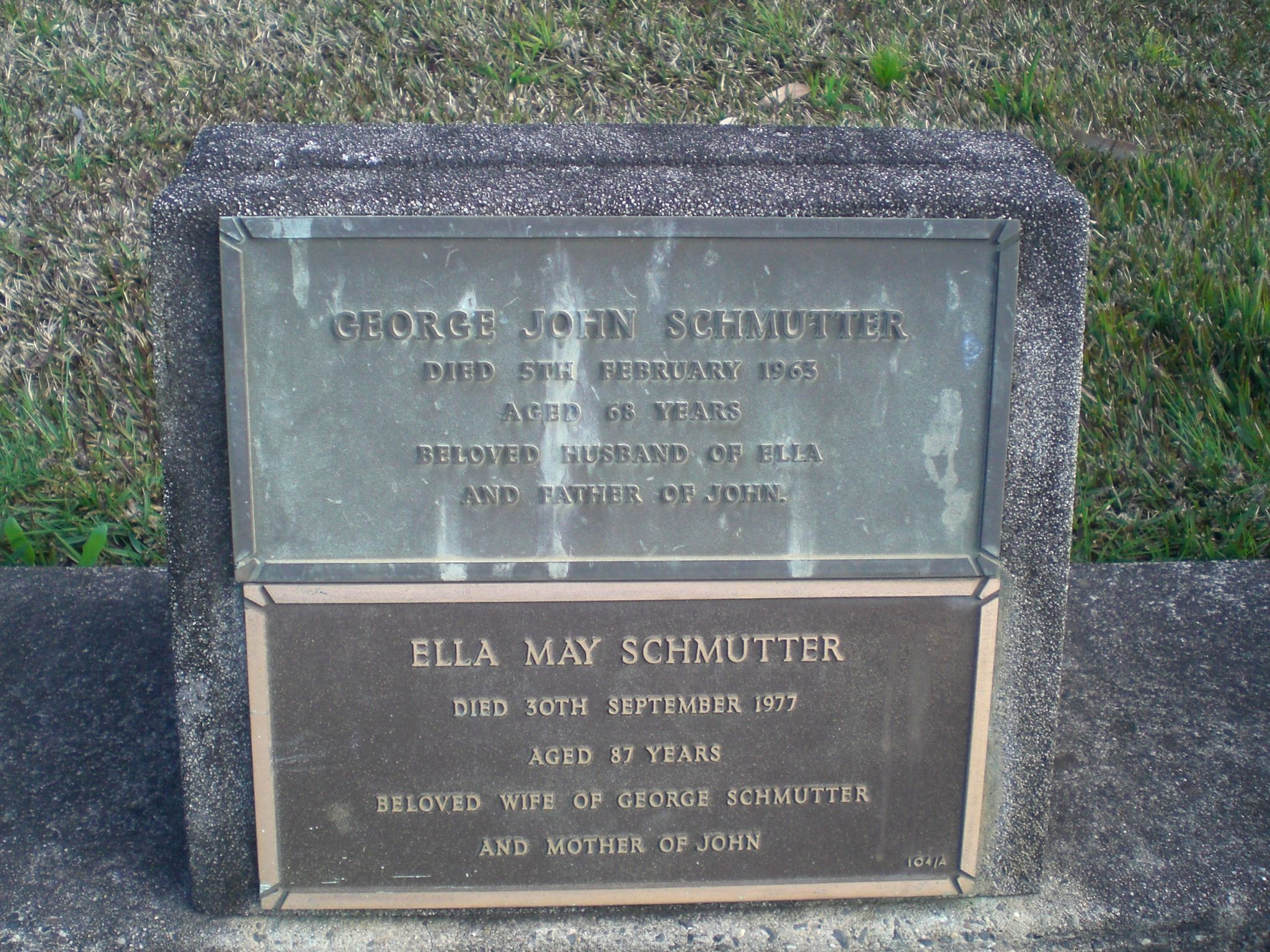

George and Ella Schmutter's memorials at Rookwood Cemetery in Sydney

There is one remaining mystery with George/Jack. As you can see from his father's death notice, below, it states that he (Jack) was late A.I.F - a  returned soldier. However, I cannot find any reference to him enlisting. To add to this mystery, the Iona Honour Board, lists a W. Schmutter, who I can't firmly identify, but I have written about this  here.


William Schmutter's death notice 


Footnotes
(1) The Koo Wee Rup Sun, October 9, 1918, see here.
(2) Indexes to the Victorian Births, Deaths and Marriages; Electoral Rolls on Ancestry.com; Olive Sippo's death notice The Age, April 13, 1929, see here;
(3) Indexes to the Victorian and the New South Wales Births, Deaths and Marriages, Electoral Rolls on Ancestry.com; 
(4)  Indexes to the Victorian Births, Deaths and Marriages, Electoral Rolls on Ancestry.com; 
Bunyip Cemetery records   http://www.ozgenonline.com/~kayemac/bunyip.htm
National Archives of Australia Second Australian Imperial Force Personnel Dossiers, 1939-1947 - read Stephen's file here   https://recordsearch.naa.gov.au/SearchNRetrieve/Interface/ViewImage.aspx?B=6123791; funeral notice The Age, July 26, 1960, p 16. newspapers.com
(5) Indexes to the Victorian Births, Deaths and Marriages;  Mary Schmutter's death notice The Age March 15, 1919, see here;  William Schmutter's death notice The Age, March 24, 1932, see here; Electoral Rolls on Ancestry.com

Wednesday, June 7, 2023

Annie the Circus Elephant who died at Koo Wee Rup

Goldwyn Brothers' Circus came to Koo Wee Rup on Wednesday, October 27, 1948; they were scheduled to perform that night, but were prevented by heavy rains and the show took place the next night. 


Advertisement for Goldwyn Brothers' Circus in Koo Wee Rup
Koo Wee Rup Sun, October 20, 1948, p. 1

However, one of their performing elephants died at Koo Wee Rup on Friday, October 29 and the Koo Wee Rup Sun  reported on this sad event - 


Death of the elephant.
Koo Wee Rup Sun November 3, 1948, p. 1

Valuable Elephant Alleged to be Killed by Noxious Weeds
While visiting Kooweerup last week Goldwyn Bros' circus had the misfortune to lose one of their two performing elephants, valued at £1000, alleged to be due to eating a noxious weed, viz., carrot fern, on a vacant allotment in the township fronting St John's Parish Hall. Billed to appear on Wednesday night, the show was postponed till the following evening owing to heavy rains. After helping to load equipment on Friday morning, the elephants were released and wandered on to the vacant allotment and were seen to be grazing most heartily on a prolific crop of the noxious weed. They, however, were soon stricken down and were in a serious condition. Drenches were immediately given, but in the afternoon one of the animals died and it was not until Saturday morning that the other elephant was able to regain its feet, when it quickly recovered. Although the circus had to forgo showing at Hastings on Friday night, the management was able to fulfil its engagement at Frankston on Monday.

What happened to the Elephant? I have been told by some locals that the elephant was buried at Koo Wee Rup, however the Dandenong Journal reported that -
Problem of Disposal of Dead Elephant
[Cranbourne Shire Health] Inspector J. Robertson  reported that while at Kooweerup Goldwyn Bros. Circus had the misfortune to lose one of two elephants, both of which were affected by fodder poisoning. Considerable delay was caused before the circus moved on, and arrangements had to be made to remove the carcase to a metropolitan boiling down works.


Disposal of the dead elephant
Dandenong Journal November 10 1948 http://nla.gov.au/nla.news-article214584143

I must admit that when I heard an elephant had died and was buried at Koo Wee Rup, I was very sceptical; so I was happy and surprised to read a reference to the elephant in Gavan Donoghue's book The Stratford Elephant Mystery & more!  Gavan's book looks at the story of a circus elephant which was said to have been killed when it struck its head on the railway bridge on the Princes Highway at Stratford, in Gippsland. To track down which elephant this may have been, he made a list of all the circus elephants (and their fate) in Australia from post 1945. One of  the elephants was Annie, who belonged to the Goldwyn Brothers' Circus. Gavan notes that Dick Bills, a former lion-tamer and Goldwyns' Circus owner, suggests Annie died from eating poison weeds at Koo Wee Rup in the 1940s. 

Armed with this information, I found the Dandenong Journal entry, which gave me a date, and then I could go to the Koo Wee Rup Sun and I found the advertisement and the short article about the elephant.

Gavan also supplied the following information about Annie - she was an Asian elephant and she was a war refugee. Annie was evacuated from England because zoos etc were being bombed and she travelled all the way to Australia. She initially belonged to Soles' Circus until she was sold to Goldwyn Brothers' Circus and then sadly met her death in Koo Wee Rup having eaten carrot fern, another name for hemlock. 

Since I wrote this post, on June 14 2023 I received this message from Gavan - I rang Dick Bills today. He was briefly the owner of Goldwyns and also a  ‘Lion Tamer’.... He said he turns 101 this year. He is an amazing old guy. Still really sharp. I told him about the documentary find by you which confirms his recall. He said Annie was a lovely natured little elephant.

The Stratford Elephant Mystery & more!  by Gavan Donoghue (published by the author in 2019, and now in its 3rd edition) Follow Gavan on Facebook  https://www.facebook.com/stratfordelephantmystery 

Saturday, May 27, 2023

Short history of the Hospitals in Koo Wee Rup

The Koo Wee Rup Regional Health Service celebrated it centenary on May 23, 2023 and even though we have looked at some aspects of the history of the Hospitals in Koo Wee Rup and the people involved in various other posts, this post includes other aspects of this history. It is not  a comprehensive history. 

The Bush Nursing Centre opened in July 1918 and a nurses' cottage was built in 1921 (1) and it was on May 23,1923 that the Bush Nursing Hospital, named the Fallen Soldiers’ Memorial Hospital, officially opened in Station Street. You can read the Koo Wee Rup Sun report of the opening, here

The Koo Wee Rup Sun report of the opening noted that much of the credit for the Hospital goes to the long serving Secretary, George Burhop, who joined the committee in 1918. As they reported - 
Now that the hospital is an accomplished fact, we cannot conclude without saying that one outstanding personality in bringing the scheme to a successful consummation has been the untiring zeal and devotion of Mr G.R. Burhop. He has been absolutely absorbed in the work. The most difficult task did not daunt him, and he has given time, money and labor and he must feel highly elated that the object for which he has been striving is now a practical reality. He has worked in a splendid spirit and has been suffused with “the white heat of a passionate enthusiasm” for the centre. (2)

Advertisement for the opening of the Hospital 
Koo Wee Rup Sun May 10, 1923, p.1 

George Randall Burhop was born in England in 1873 and died in Brisbane on May 30, 1949; he married Dorothea Pausacker in 1898 (she died 1962, aged 87) and they had four children - Dora, Amey, George and Thomas. George was a Cranbourne Shire Councillor 1921-1941 and Shire President 1927-1928.(3). 

The Koo Wee Rup Sun of June 1, 1949 had the following obituary - 
We regret to report the sudden death of Mr George Randall Burhop, J.P., of Lea road, Kooweerup, which occurred in Brisbane on Monday. Accompanied by his daughter, Amey, he left by 'plane for Brisbane last Saturday morning with the intention of spending the winter months in a warmer climate. Although not in the best of health, the news of his death came as a great shock to his family and many friends. We learn that on entering a cafe for refreshments on Monday afternoon he suddenly collapsed and immediately passed away. Following an inquiry into the cause of his death on Tuesday, Miss Burhop returned home by 'plane last night. We understand the body is to be cremated and the ashes sent to Kooweerup for private burial in an adjacent cemetery. The deceased was born in Bromley, Popular Middlesex, England on October 16, 1873, and he came to Australia with his parents, the late Mr Henry John and Mrs Amy Hannah Burhop, when 13 years of age. Living some years in Queensland and New South Wales, he came to Victoria, and in 1914 took over his father's farm on McDonald's Drain road and later purchased a much larger allotment on Lea road. He was mainly responsible for dividing the old Yallock Riding into the Lang Lang and Kooweerup Ridings, and for 17 years had most ably represented the latter riding of the Cranbourne Shire Council. He was the founder of the Kooweerup Memorial Hospital, and on December 19, 1947, was tendered a dinner and presentation by many Kooweerup and district residents in appreciation of his 28 years' services as honorary secretary of that institution. Mr McVilly, Chief Inspector of Charities, on that occasion had the honor of making the presentation of a valuable gold watch to the deceased in appreciation of his services at the hospital and 33 years' public service. Deceased was the husband of Mrs Dorothea Burhop, and father of two daughters (Dora and Amey) and two sons (George and Thomas), and to them we join with their many friends in extending our deepest sympathy in their sad bereavement.

The Fallen Soldiers' Memorial Hospital was opened by Cr E. Sinclair Hill, who also unveiled a tablet in memory of the local fallen soldiers - Jacob Bambury (listed as Banbury on the plaque), David Bethune, Sydney Blake, John Bryan, Thomas Bryan (both listed as Bryant on the plaque), Michael Callanan, Lawrence Coates, Percy Davis, John Davy, George Garbellini, Henry Hamilton, John Hannaker, Richard Martin, George Osborne, John O’Shea, James Randle, Bernard Slocombe, Arthur Williams and Charles Woods. I have written about these men, here


Dr Lyell Andrews commences practice at Koo Wee Rup
Koo Wee Rup Sun May 10, 1923, p.1 

One of the results of the Hospital opening was that in May 1923, the first Resident Doctor, Dr Lyell Andrews, arrived in the town. In February 1925, Dr Alan Hewitt and his wife, Vera, who was a trained nurse, took over Dr Andrew's practice. Dr Alan retired from practice in 1963; his son Dr John worked in Koo Wee Rup from 1951 until 1955 and another son, Dr Ian, commenced practice in the town in 1955 and retired in 1995, ending 70 years of service from the Hewitt family to the town. (4).  I wonder how many babies they delivered in that time? 

The Argus reported that on October 26, 1929, the hospital accommodation was increased by the addition of an enclosed verandah of the type common to the majority of bush nursing hospitals in Victoria....This verandah was opened on Saturday by Lady Barrett, in the presence of a large gathering of residents of Koo-wee-rup and surrounding districts. Of liberal dimensions the verandah has ample room for 10 bed, which means the accommodation of the hospital has been doubled. Lady Barrett was accompanied to Koo-wee-rup by the honorary secretary of the central council of the Bush Nursing Association (Sir James Barrett) and the assistant secretary (Dr Edith Barrett) The visitors were received by a guard of honour formed by Boy Scouts, and a welcome was signalled to them in semaphore. A bazaar was held to defray part of the cost of the verandah.

Dr Edith Barrett congratulated the committee on its enterprise in extending the hospital and paid tribute to the nursing staff, of which, she said, Koo-wee-rup had every reason to be proud. (Applause). To the zeal and resource of the bush nurses practically the whole of the success of the movement was due. Nowhere in the Commonwealth were nurses so well trained as those who entered the Bush Nursing Association. Sir James Barrett recalled the beginning of the Bush Nursing Association. To Koo-wee-rup he said, belonged the distinction of having the first hospital founded by the central council. Eight years ago the Koo-wee-rup hospital was the only institution of its kind in Victoria. To-day there were 17 bush nursing hospitals; three more were to be opened shortly, and four were in course of construction.

The report continued .....Lady Barrett then declared the verandah open, cutting a ribbon across the door. Councillor Burhop, in thanking Lady Barrett, said that he was supported by an able and energetic committee, and he felt that the management of the hospital was in very good hands. (Applause). Much of the success of the hospital was also due to the untiring work of the nursing staff, especially Sister Tuffin. The verandah had been constituted at a cost of £180. Of that amount £150 had been subscribed, and he hoped that the remainder of the debt would soon be liquidated (Applause).......Councillor Burhop announced that Sir James Barrett had informed him that the central council would meet one-third of the outstanding debt. The announcement was received with applause. (5). 

Drama struck the hospital in December 1934 when the patients had to be evacuated through the roof as the Hospital was flooded to a depth of 7ft within a few minutes. I have written about this drama, here


Advertisement for the Hospital
Koo Wee Rup Sun, September 2 1937, p.3

In October 1935, a new operating theatre was opened.  The Age reported - 
Before a large crowd at the Koo-wee-rup Memorial Hospital yesterday, the president of the Victorian Bush Nursing Association (Lady Mitchell) officially opened the new operating theatre at the hospital. Lady Mitchell was accompanied by the honorary secretary of the central council of the Victorian Bush Nursing Association (Sir James Barrett) and Lady Barrett and the visitors were welcomed by the president of the hospital (Mr L. J. O'Riordan) (6). 

The Hospital relied on subscriptions and local donations but the Pakenham Racing Club was also a major donor and every year, in the 1930s to the 1950s, held a Hospital Race Meeting to raise funds for both the Koo Wee Rup and the Pakenham Bush Nursing Hospitals. (7).

The Pakenham Racing Club's Hospital meeting

In January 1946 (or possibly late 1945), the Westernport Memorial Hospital Provisional Committee was formed for the purpose of establishing a modern public hospital in the Koo Wee Rup locality and it appeals for the support and loyal co-operation of every person residing in the area. The immediate objective was to raise £5000. (8).


The formation of the Westernport Memorial Hospital Provisional Committee 
Koo Wee Rup Sun, January 30, 1946, p. 4.

A major problem facing Hospitals after the War in the late 1940s and early 1950s was a shortage of nurses; in fact it was so dire that it was reported that some hospitals, including Koo Wee Rup, would have to close. One innovative solution to the nursing shortage was this, as The Herald reported - Staff shortages in Victorian hospitals could be eased if male nurses were accepted generally, several trained male nurses had come from England recently and there had been several Australian ex-servicemen with provisional registrations, but, with the exception of one training school, metropolitan and country hospitals did not appear to be interested in employing them…..There were between 30 and 40 trained male nurses in England willing to migrate. Some were highly qualified. One had a special certificate as a male tutor, and would give the opportunity to establish male nurse training in Victoria. (9). 

The Westernport Memorial Hospital Committee continued their fundraising and in 1953 Bates, Smart and McCutcheon were appointed as architects and the Trusteel Corporation was the successful tenderer for the new hospital, in Rossiter Road. The local community had raised £20,000 towards the cost of the building the hospital and the nurses’ home, which cost £200,500 and was constructed in seven months (10). 


The new Hospital
Koo Wee Rup Sun July 27, 1955, p. 1


December 4, 1954  - Hospital under construction.
Photographer: Margaret Robinson


November 27, 1954 - Construction of Hospital and two-storey Nurses' Home. 
Photographer: Margaret Robinson

The Koo Wee Rup Sun reported on July 20, 1955 that Matron Laird had been appointed and that the Hospital would be ready for occupation the next month, and would be officially opened on August 22. A Meeting to form a Ladies Auxiliary was held on July 28. The visiting hours for the hospital were set at 10.30am - 11am, 2.30pm - 3.30pm and 7.15pm - 8.15pm and no children under 14, except babes in arms, would be admitted as visitors. August 22 came and went and there was no official opening, however on August 24, 1955 the hospital was opened for business with the patients in the old building transferred by ambulance to the new building. The Hospital Secretary, Mr Pollock, could advertise that the hospital was open to receive patients for all kinds of nursing. (11). 


The new Hospital is open for business
Koo Wee Rup Sun August 24, 1955, p. 4

It wasn’t until December 4, 1955 that the official opening of the Hospital and Nurses’ Home took place. The Koo Wee Rup Sun would report that despite inclement weather conditions there was a large attendance on Sunday afternoon to witness the official opening of the new 23-bed Westernport Memorial Hospital, costing £200,000, excluding furnishings. The ceremony was performed by Dr. H. J. Lindell, chairman of the Hospitals and Charities Commission. (12).  You can read the full report of the opening of the Westernport Memorial Hospital, here


December 4, 1955 - Opening Ceremony Westernport Memorial Hospital
Photographer: Margaret Robinson


December 4, 1955 - Opening Ceremony Westernport Memorial Hospital. 
The Fallen Soldier's plaque was installed in this wall. 
Photographer: Margaret Robinson


The focus of the Hospital changed from the 1990s - the Killara Hostel opened in 1997, the operating theatre closed in 2004. However what didn’t change was the need to raise funds and Hospital Balls were a regular feature and a major fundraiser was the Koo Wee Rup Potato Festival held from 1973 until 2000 (read about the Potato Festival, here).  However, the jewel of the Crown is the Ladies Auxiliary, formed in July 1955 and still going strong and still raising money for the Health Service. Coming up for their 70th anniversary, a Platinum Jubilee, in two years time it is an anniversary well worth celebrating for their consistent dedication to their cause and to the town of Koo Wee Rup and surrounds. The Ladies are truly worth their weight in platinum, gold and diamonds.

The start of the Ladies' Auxiliary
Koo Wee Rup Sun, August 3, 1955, p. 4

Footnotes
(1) Read about the Bush Nursing Centre and the Nurses' Cottage here   https://kooweerupswamphistory.blogspot.com/2014/08/medical-matters-at-koo-wee-rup.html
(2) Koo Wee Rup Sun, May 24, 1923, p 4. 
(3) The details of his Council service is from The Good Country: Cranbourne Shire by Niel Gunson (Shire of Cranbourne, 1968)
(4) Mickle, David J. Mickle Memories of Koo Wee Rup (The Author, 1983) and More Mickle Memories of Koo Wee Rup (The Author, 1987); notes compiled by Jack Mills at the Koo Wee Rup Swamp Historical Society
(5) The Argus, October 28, 1929, see here. Dr Edith Barrett, was the sister of Sir James Barrett - read her Australian Dictionary of Biography entry here and Sir James' here.
(6) The Argus, October 28, 1935, see here. Lady Mitchell - read her Australian Dictionary of Biography entry here. President of the Hospital was Mr L. J. O'Riordan - Les O'Riordan - read about him here and here - Les is the sister of Margaret Hamilton.
(7) Various articles in the newspapers.
(8) Koo Wee Rup Sun, January 30, 1946, p. 4.
(9) The Herald, January 15, 1948, see hereThe Argus, May 15, 1948, see here
(10) Koo Wee Rup Sun July 27, 1955, p. 1
(11) Koo Wee Rup Sun, July 20, 1955, p. 1;  Koo Wee Rup Sun, August 24, 1955, p. 1
(12) Koo Wee Rup Sun, December 7, 1955, p. 1.